
The Ultimate Buyer's Guide to Telecalling CRM Software in India
Generating leads is only the beginning of the sales journey. The real challenge starts after the first conversation.
Every day, businesses lose qualified opportunities—not because prospects reject them, but because follow-up becomes inconsistent as sales teams grow. Missed callbacks, delayed emails, forgotten reminders, and disconnected conversations quietly reduce conversion rates without appearing in traditional sales reports.
This guide explains how Email Sequencing helps businesses build structured, predictable follow-up processes that improve sales execution. You'll learn the difference between Email Sequencing and Email Marketing, why multi-channel engagement matters, common follow-up mistakes, technical deliverability requirements, and the principles behind effective sales communication.
Whether you're managing a small sales team or scaling a growing business, this guide will help you understand why disciplined follow-up has become one of the most valuable capabilities in modern sales automation.
Table of Contents
- Every Business Generates Leads. Very Few Execute Follow-Ups Consistently
- The Hidden Cost of Inconsistent Follow-Up
- The Sales Execution Gap
- The Opportunity Decay Curve
- Why Consistency Matters More Than Volume
- Email Sequencing vs Email Marketing
- Why Email Alone Is No Longer Enough
- Manual Follow-Up vs Rule-Based Sequencing
- Six Best Practices for Better Email Sequences
- Five Mistakes That Quietly Reduce Conversion
- Choosing an Email Sequencing Platform & Technical Infrastructure
- A Practical Sales Execution Checklist
- Key Takeaways
- Frequently Asked Questions
Every Business Generates Leads. Very Few Execute Follow-Ups Consistently.
Ask almost any business owner about their biggest sales challenge and you'll hear familiar answers:
- "We need more leads."
- "Our conversion rate needs to improve."
- "We need more meetings."
- "Our sales cycle is too long."
These are genuine challenges. But beneath them lies another problem—one that rarely appears on dashboards and is often overlooked during sales reviews.
Most businesses don't lose opportunities because they fail to generate leads. They lose them because they fail to follow up consistently.
Imagine this:
- A prospect requests a product demo on Monday morning.
- Your salesperson calls within the hour but receives no answer.
- A follow-up email is sent.
- A reminder is added to a notebook or calendar.
- Tuesday becomes Wednesday.
- A customer meeting runs longer than expected.
- Several new enquiries arrive.
- The reminder slowly slips down the priority list.
By the following week, the prospect hasn't disappeared because they weren't interested. They've disappeared because another company remained consistently engaged while yours became unexpectedly silent.
Nothing dramatic happened.
Nobody deliberately ignored the prospect.
No major mistake was made.
The opportunity simply lost momentum because there wasn't a structured system ensuring every important conversation continued.
This silent breakdown happens every day across businesses of every size.
As organizations grow, salespeople become busier, pipelines become larger, buying journeys become longer, and communication channels multiply.
Consistency becomes harder to maintain.
Modern sales execution begins by solving this problem—not through more effort, but through better systems.
The Hidden Cost of Inconsistent Follow-Up
Sales rarely fail because of one significant mistake.
They fail because of dozens of small inconsistencies.
- A delayed reply
- A forgotten callback
- An unanswered email
- A missed reminder
- An inconsistent communication process
Individually, these issues appear minor.
Collectively, they reduce customer confidence, slow sales cycles, and quietly decrease conversion rates.
Many growing businesses experience the same pattern.
The more enquiries they generate, the harder it becomes to manage every conversation manually.
Ironically, success creates complexity.
What worked when the business received ten enquiries each week no longer works when the pipeline contains hundreds of active opportunities.
The challenge isn't effort.
The challenge is consistency.
Manual follow-up depends on memory.
Successful sales organizations depend on systems.
The Sales Execution Gap™
One of the biggest misconceptions in sales is believing that more leads automatically produce more revenue.
In reality, there is a crucial space between generating interest and winning a customer.
That space determines whether marketing investment becomes predictable revenue—or lost opportunity.
We call this The Sales Execution Gap™.
Lead Generated
I
First Conversation
I
SALES EXECUTION GAP
I
Consistent Follow-Up
I
Qualified Opportunity
I
Customer
Most organizations invest heavily in the top of the funnel.
They spend on advertising, referrals, SEO, partnerships, and campaigns.
Far fewer invest the same attention in what happens after someone expresses genuine interest.
The Sales Execution Gap is rarely caused by poor products or poor intentions.
It is created by inconsistent execution.
Some prospects receive timely follow-ups.
Others wait several days.
Some receive thoughtful communication.
Others receive none.
The result is a sales pipeline that looks healthy in reports but underperforms in reality.
The Opportunity Decay Curve™
Customer interest is not permanent.
It naturally changes over time.
When a prospect enquires about a service, their interest is usually highest immediately after making contact.
If no meaningful communication follows, enthusiasm gradually declines.
Competing priorities emerge.
Alternative solutions appear.
The original need becomes less urgent.
This gradual decline in engagement is what we call The Opportunity Decay Curve™.
Interest
High
I
ITimely Follow-Up
Meaningful Conversation
High
\
\
\
Lost Opportunity
The goal of sales isn't merely generating initial interest.
It is maintaining momentum until customers are ready to make informed decisions.
As pipelines grow, sustaining that momentum manually becomes increasingly difficult.
Why Consistency Matters More Than Volume
A common misconception is that better sales performance comes from sending more emails.
Usually, it doesn't.
Customers don't reward persistence for its own sake.
They respond to relevance, timing, and value.
The objective isn't increasing communication volume.
The objective is creating meaningful communication at the right moments.
Research across B2B sales consistently shows that many successful deals require multiple interactions before a buying decision is made. At the same time, many sales professionals stop following up long before prospects stop evaluating their options.
This isn't a marketing problem.
It's a sales execution problem.
What Is Email Sequencing?
Email Sequencing is a structured series of follow-up communications delivered according to predefined business rules.
Rather than depending on memory, reminders, or manual scheduling, Email Sequencing creates a repeatable communication journey that helps sales teams stay consistently engaged with prospects.
Each interaction has a purpose.
Each message builds on the previous one.
The objective is not to send more emails—it is to move one conversation forward through timely, relevant communication.
Email Sequencing vs Email Marketing
Although both involve email, their purpose is fundamentally different.
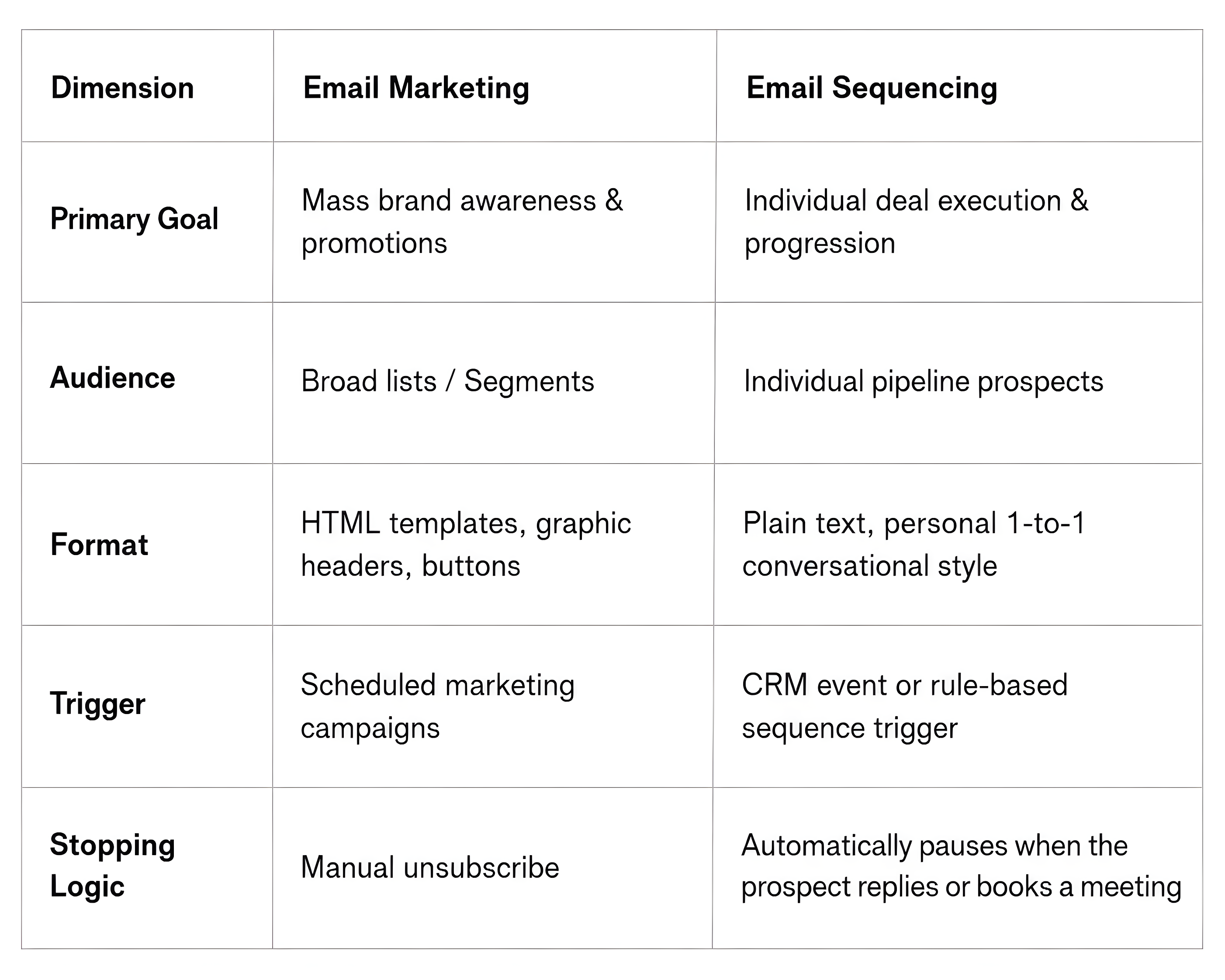
Understanding this distinction is important.
Many businesses invest heavily in email marketing while leaving sales follow-up entirely manual.
The result is strong lead generation followed by inconsistent execution.
Marketing creates opportunities.
Email Sequencing helps convert those opportunities into meaningful sales conversations.
Why Email Alone Is No Longer Enough
Today's customers don't communicate through a single channel.
Some respond to email.
Others prefer scheduled phone conversations.
Some engage through messaging platforms like WhatsApp.
Others simply need timely reminders before making a decision.
Modern sales teams therefore think in terms of complete customer journeys rather than isolated communication channels.
A structured multi-channel cadence might look like this:
- Day 1: Introduction email
- Day 3: Helpful educational content
- Day 5: Phone call reminder
- Day 8: Industry insight
- Day 12: Meeting invitation
- Day 16: Final check-in
Notice something important.
This isn't about sending more messages.
It's about delivering the right message at the right time.
Consistency builds familiarity.
Familiarity builds trust.
Trust creates conversations.
Conversations create customers.
Manual Follow-Up vs Rule-Based Sequencing
The real difference isn't automation.
The real difference is predictability.
Customers appreciate consistency.
Managers gain visibility.
Sales teams spend less time remembering what to do next—and more time building meaningful customer relationships.
Six Best Practices for Better Email Sequences
Technology doesn't make follow-up effective.
Good communication does.
The highest-performing email sequences aren't the ones that send the most emails.
They're the ones that deliver the right message, to the right person, at the right time.
1. Start With Value, Not a Meeting Request
One of the most common mistakes in sales is asking for a meeting before creating a reason for the prospect to invest their time.
Begin by helping.
Share:
- A useful industry insight
- A practical framework or checklist
- A customer success story
- A relevant case study
- An answer to a common business question
When the first interaction provides value, every future interaction becomes easier.
People rarely object to communication that genuinely helps them make better decisions.
2. Personalization Is About Context, Not Just Names
Adding a prospect's first name is easy.
Understanding their business is far more valuable.
Effective personalization comes from context.
Reference:
- Their industry
- Previous conversations
- Business challenges they mentioned
- Their stage in the buying journey
- Relevant resources based on their interests
Customers quickly recognize the difference between genuine personalization and automated token replacement.
3. Give Every Message a Purpose
A surprising number of follow-up emails simply repeat the previous message.
"Just checking if you had a chance to review my last email."
Repeatedly asking the same question rarely moves a conversation forward.
Instead, every interaction should introduce something new.
Perhaps:
- A different perspective
- A useful statistic
- A customer success story
- A practical framework
- A thoughtful question
- A helpful resource
Every communication should create another reason for the prospect to continue the conversation.
4. Maintain a Consistent Rhythm
Sales teams often fall into one of two extremes.
Either they disappear for several weeks…
or they send multiple emails within two days.
Neither approach builds trust.
Consistency matters more than intensity.
A predictable communication rhythm demonstrates professionalism without overwhelming the customer.
5. Make Responding Easy
The easier it is for prospects to respond, the more likely they are to engage.
Instead of asking:
"Let me know if you'd like to discuss this further."
Try asking:
"Would Tuesday or Thursday work better for a brief 15-minute discussion?"
Small improvements in clarity often produce significant improvements in response rates.
6. Measure Conversations, Not Just Clicks
Open rates matter.
Click-through rates matter.
But neither closes deals.
Meaningful conversations are the real objective.
Instead of asking:
"How many emails did we send?"
Ask:
"How many opportunities moved meaningfully forward?"
That shift changes how sales teams evaluate success.
Five Mistakes That Quietly Reduce Conversion
Even well-designed follow-up strategies become less effective when small habits begin creeping into the process.
Recognizing these patterns early helps businesses avoid unnecessary friction.
Waiting Too Long
Customer interest naturally declines over time.
Prompt communication demonstrates professionalism while maintaining buying momentum.
Sending Generic Templates
Customers immediately recognize messages written for everyone.
Relevant communication consistently performs better than generic communication.
Ignoring Previous Conversations
Every follow-up should acknowledge where the relationship currently stands.
Context creates continuity.
Without it, every email feels like the first conversation.
Using Every Channel Simultaneously
Email.
Phone.
SMS.
WhatsApp.
LinkedIn.
Using every communication channel at once doesn't increase engagement.
It creates noise.
Choose channels thoughtfully.
Allow time between interactions.
Respect the customer's attention.
Treating Every Prospect the Same
Different industries buy differently.
Different decision-makers evaluate differently.
Different businesses move at different speeds.
Great sales execution adapts to the customer rather than forcing every prospect through an identical sequence.
Choosing an Email Sequencing Platform & Technical Infrastructure
Technology should simplify sales execution—not make it more complicated.
Before comparing feature lists, ask a more important question:
Will this platform help our team communicate more consistently?
A capable Email Sequencing platform should provide both operational efficiency and reliable email delivery.
Core Platform Capabilities
Look for a platform that offers:
- Rule-based automation
- CRM integration
- Complete conversation history
- Activity tracking
- Team visibility
- Flexible scheduling
- Multi-channel task management
- Analytics and reporting
- Workflow scalability
- Simple administration
The objective isn't finding the platform with the most features.
It's finding one that helps your team execute consistently.
Essential Deliverability Infrastructure
Even the best-written email sequence has little value if it never reaches the recipient's inbox.
When evaluating an Email Sequencing platform, consider whether it supports:
Domain Authentication
A reliable platform should support industry-standard authentication protocols such as:
- SPF (Sender Policy Framework)
- DKIM (DomainKeys Identified Mail)
- DMARC (Domain-based Message Authentication, Reporting & Conformance)
These standards help receiving mail servers verify that your emails originate from legitimate sources, improving inbox placement and protecting your domain reputation.
Intelligent Sending Controls
Sending hundreds of emails at the exact same moment can negatively impact deliverability.
Look for features such as:
- Randomized sending intervals
- Configurable daily sending limits
- Inbox warm-up support
- Domain reputation management
These capabilities help maintain consistent email performance while reducing the likelihood of spam filtering.
Automated Stop Logic
One of the most overlooked features in Email Sequencing is intelligent stop logic.
A sequence should automatically pause when:
- A prospect replies
- A meeting is scheduled
- An opportunity moves to the next stage
- The contact opts out
This prevents unnecessary follow-up emails, improves the customer experience, and keeps communication relevant.
From Strategy to Execution
Understanding Email Sequencing is only the first step.
Execution is where businesses begin separating themselves from competitors.
Successful sales organizations don't rely on exceptional memory.
They rely on clearly designed systems.
Every enquiry receives timely attention.
Every conversation has a defined next step.
Every salesperson understands the follow-up process.
Technology supports discipline.
People build relationships.
The strongest sales teams never confuse automation with personalization.
Automation creates consistency.
People create trust.
Both are essential.
A Practical Sales Execution Checklist
Before introducing automation into your sales process, ask these five questions:
Does every enquiry receive a timely first response?
Does every opportunity have a clearly defined next step?
Can managers easily identify stalled conversations?
Is follow-up dependent on memory or supported by a repeatable process?
Does the customer experience feel helpful rather than persistent?
If several of these questions are difficult to answer, the opportunity isn't necessarily to automate more.
It's to build a better sales system.
Key Takeaways
- Businesses rarely lose opportunities because of poor products. More often, they lose them because promising conversations lose momentum.
- Email Sequencing creates consistency, structure, and visibility throughout the sales process.
- Great sales execution depends on systems—not exceptional memory.
- Multi-channel engagement works best when every interaction has a clear purpose.
- Automation should support people, not replace them.
- Consistent communication builds trust, and trust creates long-term customer relationships.
Conclusion
Sales has never been about sending the highest number of emails.
Nor has it been about purchasing the most sophisticated software.
It has always been about maintaining meaningful conversations until customers are ready to make informed decisions.
Email Sequencing doesn't replace great salespeople.
It helps great salespeople remain consistently engaged.
As businesses grow, maintaining that consistency manually becomes increasingly difficult.
Pipelines expand.
Teams become larger.
Customer expectations continue to evolve.
The organizations that succeed aren't necessarily the ones with the largest marketing budgets.
They're the ones that build repeatable systems that ensure every genuine opportunity receives the attention it deserves.
Because customers rarely buy after receiving one perfect email.
They buy from businesses that remain relevant, responsive, and helpful throughout their decision-making journey.
Technology doesn't close deals. Consistent execution does.
Email Sequencing isn't about automating communication for the sake of efficiency. It's about ensuring every meaningful conversation receives the attention it deserves. Businesses that build disciplined follow-up systems don't simply send more emails—they create more opportunities, stronger customer relationships, and more predictable revenue.
That is the real value of Email Sequencing.
Not automation for its own sake.
But disciplined sales execution that transforms more conversations into customers.
Frequently Asked Questions
What is Email Sequencing?
Email Sequencing is a structured series of follow-up communications delivered according to predefined business rules that help sales teams maintain consistent communication with prospects throughout the buying journey.
Is Email Sequencing the same as Email Marketing?
No. Email Marketing targets large audiences with newsletters, promotions, and announcements.Email Sequencing supports one-to-one sales conversations by delivering structured follow-ups that move individual opportunities forward.
Does Email Sequencing improve sales performance?
Email Sequencing improves consistency, reduces missed follow-ups, and helps sales teams maintain momentum with prospects. While results depend on message quality, timing, and the overall sales process, a structured follow-up approach generally supports better sales execution.
How many follow-ups should a sales team send?
There is no universal number.The ideal cadence depends on your industry, buying cycle, customer preferences, and the value each interaction provides.Quality and relevance are far more important than volume.
Can small businesses benefit from Email Sequencing?
Absolutely.Small businesses often benefit significantly because structured follow-up reduces manual effort while helping lean sales teams manage growing pipelines more consistently.
Does Email Sequencing replace personal communication?
No. It automates routine scheduling and reminders while allowing sales professionals to focus on meaningful conversations and relationship building.
What makes an effective Email Sequence?
An effective sequence combines:- Clear objectives
- Relevant messaging
- Appropriate timing
- Personalization
- Consistency
- Valuable content
- A clear next step
Clear objectives
Relevant messaging
Appropriate timing
Personalization
Consistency
Valuable content
A clear next step