

WhatsApp Business API pricing in India is not a single monthly fee. Your actual cost typically combines Meta's per-message charges with your WhatsApp platform or provider fee, plus any optional users, automation, integrations and applicable taxes.
For Indian numbers, current 2026 benchmark rates are approximately ₹0.8631 per marketing message and ₹0.1150 per utility or authentication message. Customer-service replies within the applicable 24-hour service window can be free under Meta's pricing rules.
That means a platform advertised at ₹999/month does not necessarily cost only ₹999 once you start sending messages.
WhatsApp Business API Pricing in India: Quick Answer
There are usually two main layers to your WhatsApp API cost:
- Meta messaging charges — based on message category, recipient market and usage.
- Platform/provider charges — the software you use for inbox management, campaigns, automation, CRM integration and related capabilities.
Your total can also include additional users, WhatsApp numbers, automation, integrations, implementation and applicable taxes.
2026 WhatsApp API message rates in India
2026 WhatsApp API message rates in India
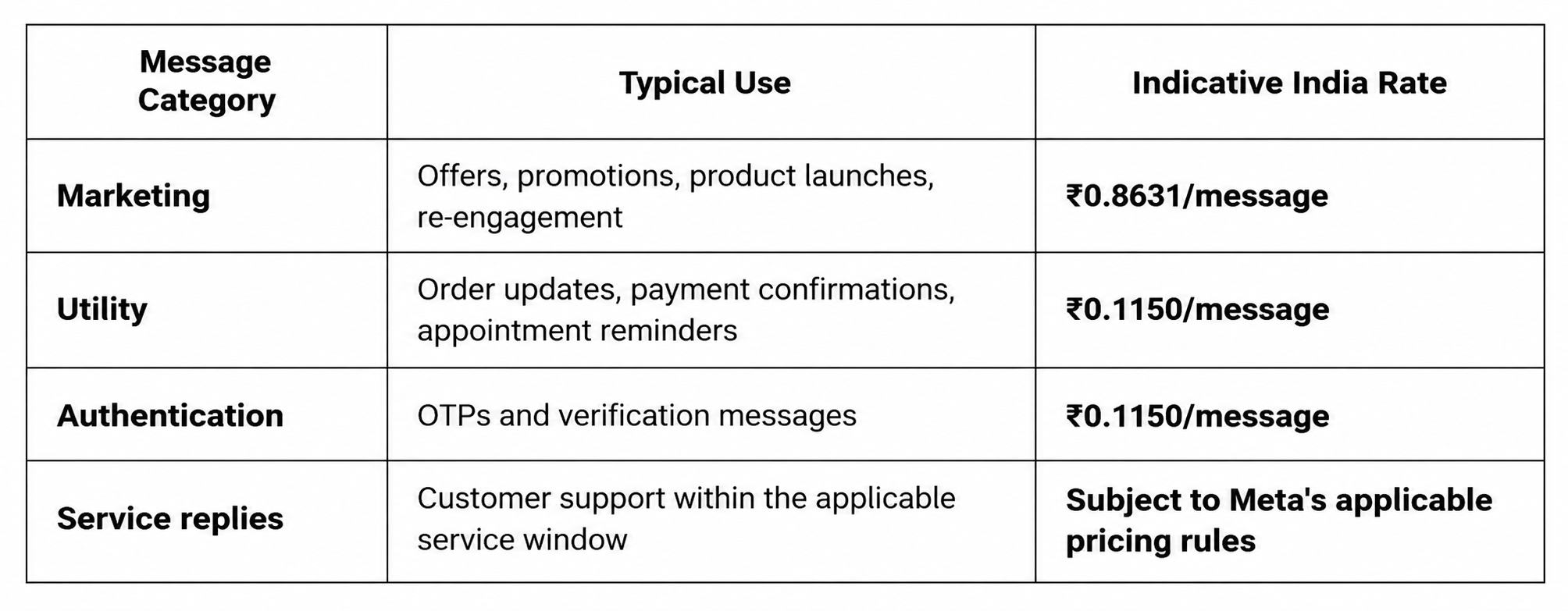
Meta moved applicable template messaging from conversation-based pricing to per-message pricing in July 2025. Rates can change, so verify the latest Meta rate card when budgeting a high-volume campaign.
How Does WhatsApp Business API Pricing Work?
The simplest formula is:
Monthly WhatsApp API Cost = Meta message charges + platform/provider fees + optional add-ons + applicable taxes
This matters because the monthly price displayed by a WhatsApp software provider may represent only one part of the total expense.
For example, a provider might advertise a ₹999 platform plan. If your company sends thousands of paid marketing templates every month, Meta's usage charges can be much larger than the platform subscription itself.
What Makes Up the Total WhatsApp API Cost?
1. Meta message charges
Meta charges for applicable delivered business template messages according to their category and the recipient's market.
For example:
10,000 marketing messages × ₹0.8631 = ₹8,631
By comparison:
10,000 utility messages × ₹0.1150 = ₹1,150
Marketing messages therefore have a significantly different cost profile from utility messages.
Businesses should classify templates correctly based on their actual purpose rather than attempting to classify promotional messages as utility messages simply to reduce costs.
2. Platform or BSP fees
Many businesses use a WhatsApp software platform or Business Solution Provider rather than building everything directly against the API.
Depending on the provider, the platform can provide capabilities such as:
- Shared inboxes
- Template management
- Broadcast campaigns
- Contact management
- Chatbots
- Workflow automation
- Reporting
- CRM integrations
Pricing models vary. Providers may charge monthly subscriptions, annual plans, per-user fees, usage-based fees or combinations of these.
3. Provider markups
Another question to ask is whether your provider passes Meta's messaging charges through directly or adds its own margin.
At low volume, a small markup may have limited impact. At tens or hundreds of thousands of messages, it can become significant.
Ask your provider:
“What is Meta's underlying charge, and what do you charge on top of it?”
4. Users, automation and other costs
Your final WhatsApp Business API cost may also include:
- Additional agents
- Additional WhatsApp numbers
- Automation
- Chatbots
- AI functionality
- CRM functionality
- Custom integrations
- Implementation
- Premium support
- Applicable GST
Always compare total expected monthly cost, not just the headline subscription price.
Can a ₹999 WhatsApp API Plan Become a ₹15,000 Bill?
Yes, but not automatically. A ₹999 platform plan can result in a much larger total bill when significant messaging usage, optional services and taxes are added.
Consider this illustrative scenario:
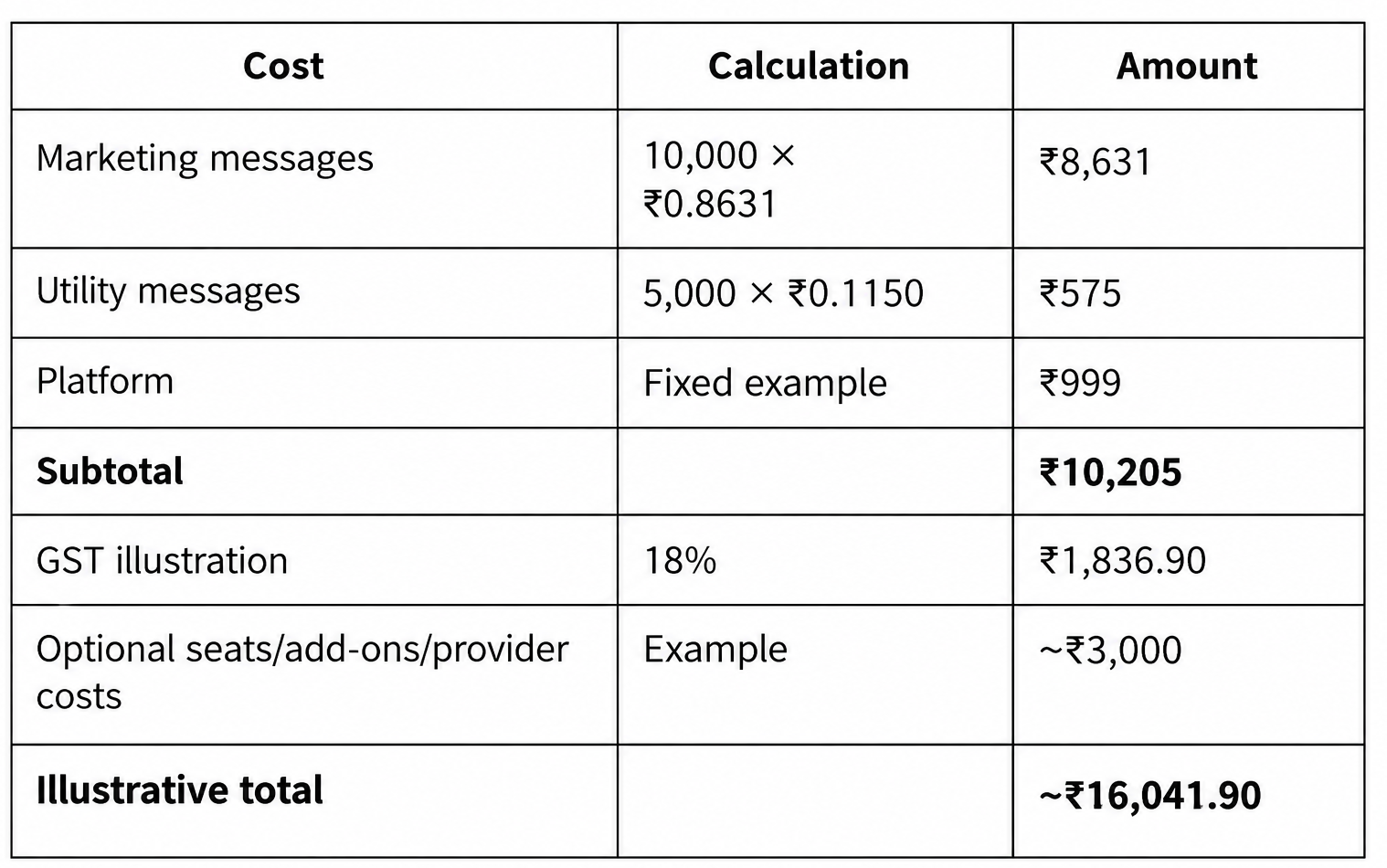
This is an illustrative scenario, not a standard market price. Actual invoices depend on your provider, message mix, contract, tax treatment and optional services.
The important lesson is that ₹999 may describe the software subscription rather than your complete WhatsApp operating cost.
WhatsApp API Cost Examples by Business Size
Small business
Suppose you send:
- 500 marketing messages
- 500 utility messages
Estimated Meta messaging cost:
Marketing: 500 × ₹0.8631 = ₹431.55
Utility: 500 × ₹0.1150 = ₹57.50
Utility: 500 × ₹0.1150 = ₹57.50
Total Meta usage: approximately ₹489.05
You would then add your platform/provider costs and applicable additional charges.
Growing sales team
Suppose you send:
- 10,000 marketing messages
- 5,000 utility messages
Your estimated Meta usage would be:
₹8,631 + ₹575 = ₹9,206
At this volume, messaging can become a much larger part of the monthly bill than a low-cost platform subscription.
High-volume business
Suppose an e-commerce or enterprise business sends:
- 100,000 marketing messages
- 50,000 utility messages
Estimated usage:
Marketing: ₹86,310
Utility: ₹5,750
Utility: ₹5,750
Total: approximately ₹92,060 before platform/provider costs and applicable taxes.
At this scale, message strategy and provider pricing become particularly important.
What Is the Real Cost of a WhatsApp Lead?
Businesses should not evaluate WhatsApp only by asking:
“How much does one message cost?”
A more useful business question is:
“How much does WhatsApp cost per qualified lead or sale?”
For example, suppose 10,000 marketing messages cost ₹8,631 and generate:
- 500 responses
- 100 qualified leads
- 20 sales
Then:
Messaging cost per qualified lead = ₹86.31
Messaging cost per sale = ₹431.55
Whether ₹431.55 per sale is expensive depends on the value and margin of the sale.
This is why message price alone does not tell you whether a WhatsApp campaign is profitable.
The Hidden Cost: Leads That Never Get Followed Up
A business can optimize message costs and still lose money if its sales process breaks after the customer responds.
Imagine paying for advertising, capturing a lead and sending a WhatsApp message—only for the reply to remain unanswered.
The lost opportunity can be worth much more than the messaging charge.
A structured process should connect:
Lead capture → WhatsApp conversation → Lead assignment → Follow-up → Pipeline → Conversion
This is one reason CRM integration becomes increasingly important as WhatsApp lead volume grows.
How Flowzo Connects WhatsApp With Sales Workflows
Flowzo integrates with the official WhatsApp Business API and connects WhatsApp conversations with CRM workflows. Its current WhatsApp integration includes shared team conversations, broadcasts, template management, automated qualification flows and chat histories associated with customer records.
For teams using WhatsApp as a sales channel, the objective is not simply to send more messages. It is to make sure customer responses become trackable sales activity.
Flowzo currently lists WhatsApp Automation as an add-on at ₹15,000/year, while its pricing structure should be checked directly for the latest terms and inclusions.
How to Reduce WhatsApp Business API Costs
You do not necessarily need to send fewer messages. You need to reduce unnecessary messaging and improve the value of each interaction.
- Segment audiences carefully. Avoid sending every campaign to your entire contact database.
- Use the correct message category. Transactional communications that genuinely qualify as utility messages have different pricing from marketing messages.
- Avoid unnecessary repeat broadcasts. Repeatedly messaging unresponsive contacts increases spend without guaranteeing additional revenue.
- Track conversions, not only delivery rates. Measure responses, qualified leads, meetings, opportunities and sales.
- Connect responses to follow-up workflows. A successful campaign creates little value if interested customers are not contacted afterward.
What Should You Ask a WhatsApp API Provider?
Before selecting a WhatsApp provider, ask:
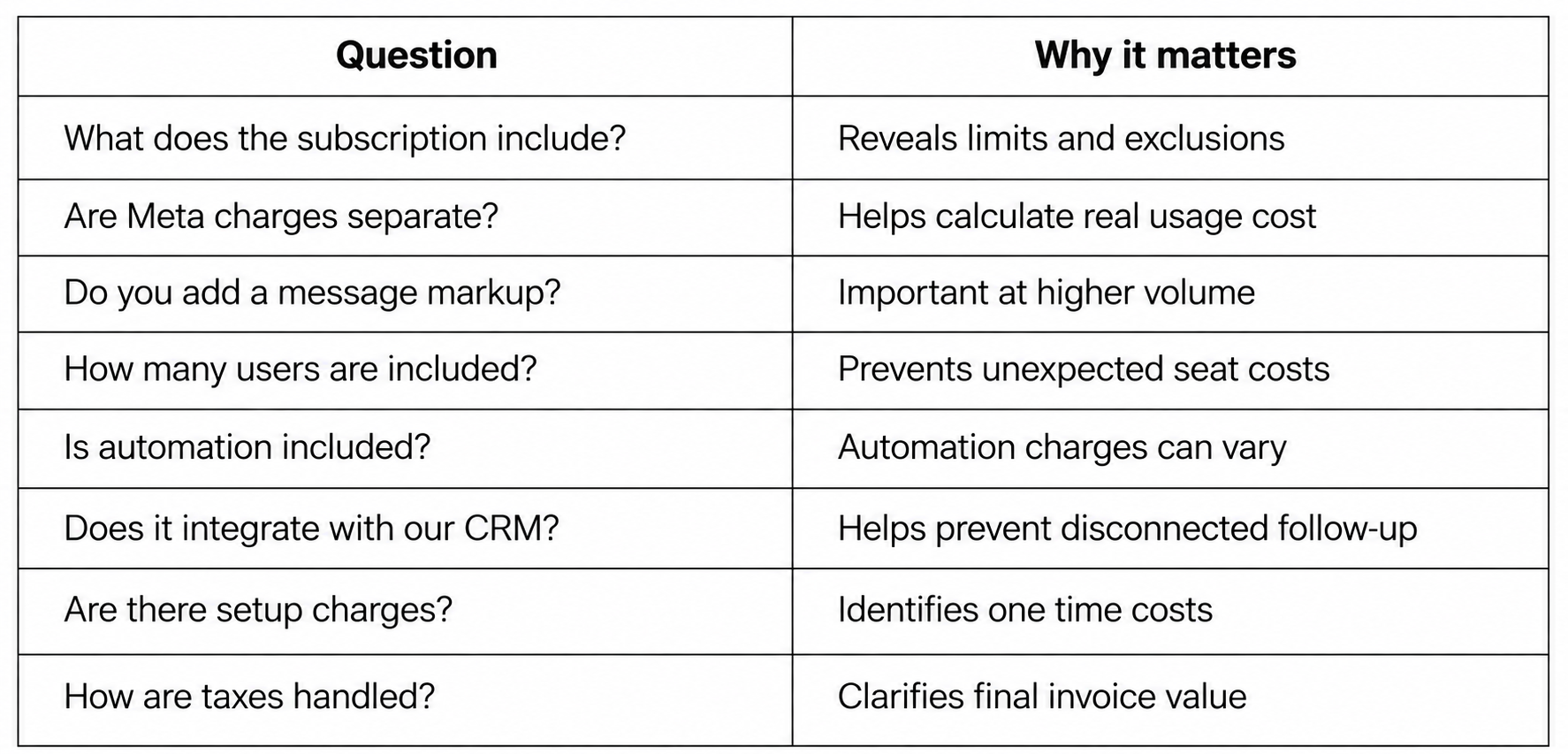
This comparison is more useful than choosing a provider simply because its homepage advertises the lowest monthly plan.
Final Takeaway
Final Takeaway
WhatsApp Business API pricing in India should be evaluated as a total cost, not a headline subscription price.
For 2026 budgeting, consider Meta's per-message charges, your platform/provider fee, message mix, optional users and automation, provider markups and applicable taxes.
A ₹999 plan can therefore cost substantially more when usage increases—but that does not make the plan itself misleading. It means businesses need to understand exactly what the advertised price includes.
More importantly, measure what happens after you pay for the message. If WhatsApp responses are assigned, followed up and converted systematically, messaging becomes part of a measurable sales process rather than simply another communication expense.
Manage WhatsApp Leads From Conversation to Conversion
Flowzo connects WhatsApp Business API communication with CRM, automation and sales follow-up so teams can manage customer conversations within a structured sales workflow.
Frequently Asked Questions
Is WhatsApp Business API free in India?
No, not generally. The WhatsApp Business App and WhatsApp Business Platform/API are different products. Businesses using the API can incur Meta messaging charges plus costs from their platform or provider.
What does Meta charge for WhatsApp messages in India in 2026?
Current 2026 references report approximately Rs 0.8631 per marketing message and Rs 0.1150 per utility or authentication message for Indian recipients. Service replies within the applicable customer-service window can be free.
Why is WhatsApp marketing more expensive than utility messaging?
Marketing templates are designed for promotional communication such as offers and re-engagement, while utility templates relate to specific customer transactions or requests. Meta prices these categories differently.
Is a Rs999 WhatsApp API plan enough for a small business?
Possibly. A low-volume business may have modest messaging costs, but you must check what the Rs999 includes. Meta charges, users, automation, integrations and taxes may be separate.
How do I calculate WhatsApp API cost?
Use:
Meta message charges + platform/provider fee + users/add-ons + provider markup + applicable taxes = estimated monthly cost.
Calculate each message category separately because the rates differ.
Do I need a BSP?
Not every implementation has identical requirements. Technical teams can use Meta's Cloud API, while many businesses choose a software platform or provider because they need shared inboxes, campaigns, automation, reporting and CRM connectivity.