
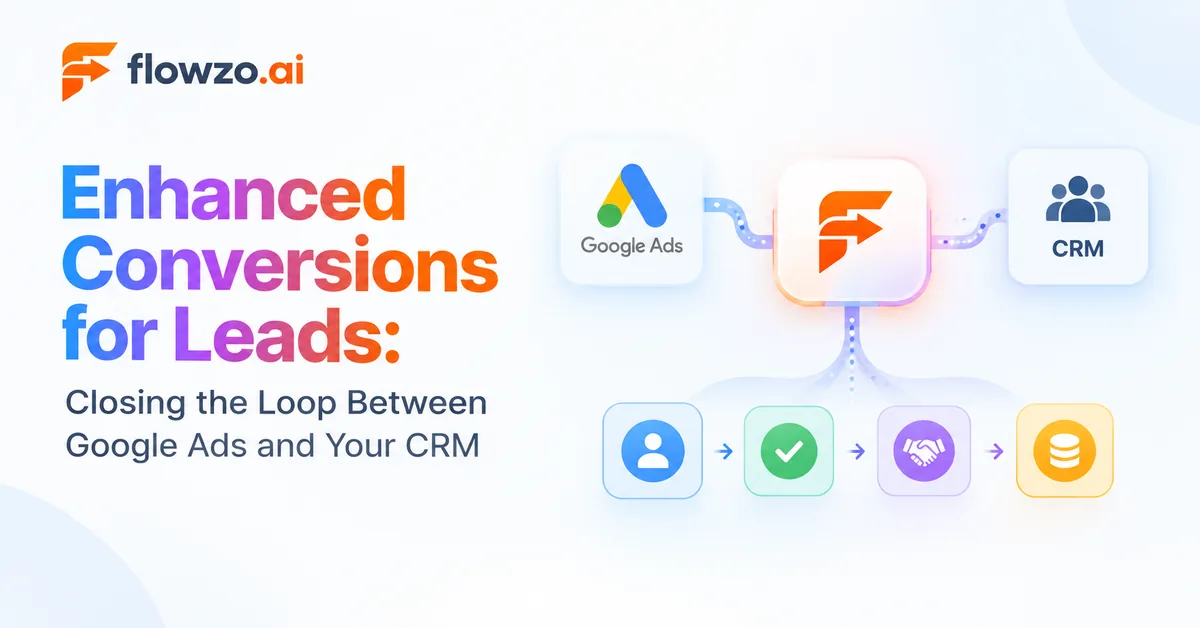
A lead fills out your form. Google Ads logs it as a conversion. Then your CRM takes over, and the actual sales process starts — the part Google Ads usually never sees.
Maybe the lead gets qualified. Maybe a meeting gets booked, a proposal goes out, and eventually a deal closes. Or maybe none of that happens.
Either way, Google Ads is often stuck with the same signal it had the moment the form was submitted, with no idea what came after.
That's the gap Enhanced Conversions for Leads is built to close.
Google Ads knows which ad brought the lead in. Your CRM knows what actually happened to it. This feature connects those two facts.
For a business with a longer sales cycle, that distinction matters.
A form submission usually isn't the outcome you actually care about — it's the first checkpoint.
The more useful question isn't:
"How many leads did this campaign generate?"
It's:
"Which of those leads turned into something real?"
If you haven't read the earlier guides in this series, start with:
- Google Ads Enhanced Conversions: Complete Guide for 2026
- How to Set Up Google Ads Enhanced Conversions
This article builds on both and focuses specifically on the Enhanced Conversions for Leads use case.
What Are Enhanced Conversions for Leads?
Google describes Enhanced Conversions for Leads as an upgraded version of offline conversion import.
The mechanism itself is straightforward.
When someone submits a lead form, first-party details they've provided — such as an email address or phone number — can be hashed and used as part of the matching process.
Later, when that lead reaches a meaningful stage in your sales process, the corresponding customer information can be imported with the offline conversion, allowing Google to match the outcome back to relevant ad interactions.
Laid out as a path, it looks like this:
Google Ad → Website → Lead Form → CRM → Lead Outcome → Google Ads
The important part isn't the form submission.
It's what happens after.
Instead of measurement stopping the moment someone clicks Submit, you can define what actually counts as a meaningful downstream outcome and send that information back to Google Ads.
A typical progression might look like:
Lead submitted → Qualified lead → Converted lead
Google recommends using conversion goals such as Qualified Lead or Converted Lead when creating new conversion actions for Enhanced Conversions for Leads.
Why a Form Submission Isn't Always the Conversion That Matters
Here's a simple way to see the problem.
Picture two campaigns running side by side.
Campaign A
- 1,000 clicks
- 100 form submissions
- 80 unqualified leads
- 15 qualified leads
- 3 customers
Campaign B
- 700 clicks
- 60 form submissions
- 35 qualified leads
- 10 customers
These are made-up numbers, not data from a real account. They are included only to illustrate the difference between lead volume and lead quality.
Judged purely on form submissions, Campaign A looks like the stronger performer.
But form volume isn't necessarily the business outcome that matters.
What actually matters varies by business, but it may include:
- Qualified leads
- Sales opportunities
- Booked meetings
- Converted leads
- Signed contracts
- Paying customers
Enhanced Conversions for Leads gives advertisers a way to bring meaningful offline outcomes back into Google Ads.
It doesn't decide which outcome matters for your business.
Your conversion strategy does.
How Enhanced Conversions for Leads Connects Google Ads and Your CRM
It helps to think of this as two connected stages rather than one continuous process.
Stage 1: The website generates the lead
Someone clicks your ad, lands on your website, and fills out a form.
Where your setup captures first-party customer information — such as an email address or phone number — that information can be hashed and used for Enhanced Conversions for Leads.
Google's implementation documentation describes the website tag or Google Tag Manager as the mechanism for collecting and hashing user-provided data.
Stage 2: Your CRM sends the outcome back
This is where the measurement loop becomes more useful.
As a lead moves through your sales process — qualified, disqualified, converted into an opportunity, or eventually closed — the relevant conversion outcome can be imported back into Google Ads.
The matching can use hashed first-party customer data along with Google identifiers such as the GCLID where available.
Google specifically recommends continuing to include GCLIDs when possible to maximize accuracy.
The data flow needs an ongoing import process.
Depending on the setup, this can involve Google Ads Data Manager, a supported direct CRM connection, or an applicable API/integration path.
Google recommends Data Manager for offline conversion and Enhanced Conversions for Leads workflows.
A CRM that tracks every lead beautifully but never sends the relevant outcomes back to Google Ads leaves the advertising measurement loop incomplete.
The crucial rule: Don't pre-filter by assumed attribution
One detail that often causes confusion is deciding which conversions should be uploaded.
Google's guidance is designed around sending the conversions for the tracked event rather than trying to determine in advance which ones you personally believe came from Google Ads.
Google's systems perform the attribution and can identify conversions that aren't attributable to Google Ads.
Your CRM records what happened to the lead.
Google Ads determines whether that outcome can be attributed to an eligible ad interaction.
Choosing Your Conversion Goals: Qualified Lead vs. Converted Lead
Google recommends Qualified Lead and Converted Lead as conversion goals for new Enhanced Conversions for Leads actions.
Qualified Lead
A lead that has been reviewed by your team and confirmed as a genuine fit.
It's more meaningful than simply saying someone submitted a form.
Converted Lead
A further downstream outcome.
For one business, that might mean a closed deal.
For another, it could represent a clearly defined sales outcome further along the funnel.
The important point is to define the stage consistently inside your own sales process.
Why the goal type matters
Using the purpose-built lead conversion goals can provide access to Google's Lead Journey Mapping and lead funnel report.
That gives advertisers visibility into how leads move through stages such as leads, qualified leads, and converted leads.
A generic custom conversion may not provide the same lead-funnel visibility.
Keep Google Ads and CRM terminology aligned
There's also a simple operational principle worth following:
Your Google Ads conversion action names should make sense alongside your CRM stage names.
If your CRM uses "Sales Accepted," don't casually rename that stage "Qualified Lead" in Google Ads unless your team has agreed that the two terms represent the same business event.
Otherwise, marketing and sales can end up using different names for what they believe is the same stage.
Primary vs. Secondary: Validating Before You Commit
When setting up a new Enhanced Conversions for Leads conversion action, Google recommends marking the new conversion action as secondary for the first 2–3 weeks.
The reason is practical.
A secondary conversion action can still appear in reporting, allowing you to inspect the incoming data without immediately making the new action part of the primary bidding optimization signal.
That gives you a time window to check whether:
- Conversion volumes look reasonable
- Conversion timing makes sense
- CRM outcomes are arriving correctly
- Matching appears to be working
- Any implementation errors are showing up in diagnostics
Once you've validated the data, the new conversion action can be moved to primary when appropriate.
If you're migrating from an existing offline conversion setup, Google's migration guidance also recommends allowing sufficient conversion history before switching optimization from the older action to the new one.
The exact migration timing can therefore differ from the initial 2–3 week validation recommendation.
What Changed in 2026?
Enhanced Conversions for web and Enhanced Conversions for Leads have moved into a more unified setup.
Starting in April 2026, Google Ads began accepting user-provided data from website tags, Data Manager, and API connections simultaneously.
Google then moved toward a unified Enhanced Conversions setting rather than requiring advertisers to choose between separate implementation methods.
There is also an important change for offline conversion and Enhanced Conversions for Leads uploads.
Starting June 15, 2026, Google moved these uploads toward the Data Manager API, with the older Google Ads API upload path blocked for developer tokens that did not retain legacy access.
Google recommends using Data Manager for current and future offline conversion and Enhanced Conversions for Leads uploads.
If your organization still relies on an older API-based upload process, this is something to verify rather than assume.
Common Mistakes Specific to Leads Tracking
1. Pre-filtering conversions
Uploading only the leads you assume came from Google Ads instead of allowing Google's systems to determine attribution can undermine the measurement process.
2. Skipping the validation window
Moving a new conversion action directly to primary before confirming that the incoming data is correct can cause unvalidated conversion signals to influence bidding.
3. Using generic custom conversions
Using a generic conversion instead of the Qualified Lead or Converted Lead goal types can mean losing lead-specific reporting capabilities such as Lead Journey Mapping.
4. Mismatched naming conventions
If your CRM calls a stage "Sales Accepted" while Google Ads calls it "Qualified Lead," teams may interpret reports differently even when they believe they're discussing the same stage.
5. Dropping the GCLID
When GCLID is available, don't unnecessarily discard it.
Google recommends continuing to provide GCLIDs where possible because they can strengthen measurement and attribution alongside user-provided data.
6. Leaving consent information unpopulated
Consent information is part of Google's implementation requirements and should be handled according to the applicable Google Ads customer-data policies and your consent setup.
Conclusion
A form submission tells you an ad was compelling enough to get someone to fill something out.
It doesn't tell you whether that person was ever a real prospect.
Enhanced Conversions for Leads is designed to close that gap — connecting the ad interaction Google Ads knows about with the offline outcome your CRM records, using available matching signals such as hashed first-party data and GCLID.
The technical setup is only part of the equation.
The bigger measurement decision is choosing conversion goals that reflect meaningful business outcomes, sending the appropriate conversion data consistently, and giving new conversion actions enough time to validate before they influence optimization.
That is what turns lead tracking from a simple form-counting exercise into a measurement loop that connects advertising with what actually happens in the sales process.
Frequently Asked Questions
What's the difference between Enhanced Conversions for Leads and standard offline conversion import?
Google describes Enhanced Conversions for Leads as an upgraded version of offline conversion import.
It adds hashed first-party customer data to offline conversion data to improve conversion matching and measurement.
Do I need to modify my lead forms to use this?
Not necessarily.
Enhanced Conversions for Leads can use first-party information already collected through an existing lead process, but the exact implementation depends on how your website, CRM, tagging, and Google Ads data flow are configured.
Which conversion goal should I use — Qualified Lead or Converted Lead?
It depends on the outcome you're trying to measure.
Qualified Lead fits a stage where your team has reviewed and qualified the lead.
Converted Lead fits a further downstream outcome, such as a completed sale or another clearly defined conversion stage.
Some businesses may use both as separate conversion actions representing different stages of the funnel.
Should a new leads conversion action be primary or secondary at first?
Secondary.
Google's current implementation checklist recommends keeping a new Enhanced Conversions for Leads conversion action secondary for the first 2–3 weeks so the data can be validated before it is used for optimization.
Do I need to upload every lead, or just the ones I think came from Google Ads?
Google's guidance is to upload the conversions for the tracked event rather than pre-filtering them based on your assumption about Google Ads attribution.
Google's systems determine whether an uploaded conversion can be attributed to an ad interaction.
How does this connect to what my CRM already tracks?
Your CRM remains the system that records the lead's business outcome.
You define which CRM stages correspond to your Google Ads conversion actions, and an ongoing import or integration process sends those outcomes to Google Ads.
The result is a connection between the advertising interaction and what happened to the lead after it entered your sales process.