
Search Has Changed: From Finding Links to Getting Answers
For more than two decades, digital visibility followed a familiar formula: publish content, optimize it for search engines, rank well and win the click.
The search results page was the gateway. Buyers entered a query, scanned a list of links, opened several websites and compared the options themselves.
That journey is now expanding.
When people research products or services, they do not always want to open ten tabs and piece the answer together on their own. Increasingly, they ask AI-powered experiences such as ChatGPT, Perplexity, Gemini and Google AI features to help them understand a problem, compare options and narrow their choices.
The journey is changing:
Old:
Search → Scan results → Open websites → Compare manually
Search → Scan results → Open websites → Compare manually
New:
Ask → AI synthesizes information → Receive an answer → Continue evaluating or act
Ask → AI synthesizes information → Receive an answer → Continue evaluating or act
The search experience is no longer only about finding a path to an answer. Increasingly, part of the answer is delivered before the customer ever visits a website.
That creates a new challenge for marketers.
Ranking still matters. But ranking alone is no longer enough to explain how a brand is discovered.
The next question is:
When a potential customer asks an AI platform for a recommendation, will your brand be part of the answer?
1. Search Has Changed: From Finding Links to Getting Answers
Traditional search was largely built around keywords.
A user might search:
Best CRM software
They would receive a list of results, visit several websites and compare the available options.
AI-driven search changes the interaction.
The same buyer may now ask:
What is a reliable CRM for a 15-person sales team that integrates with WhatsApp, automates follow-ups and is easy to implement?
That single prompt contains far more context than a traditional keyword.
It includes:
- Company size
- Use case
- Required features
- Implementation preference
- Specific business problem
Instead of simply returning a list of pages, an AI-driven experience can interpret those requirements, bring together relevant information and help the buyer narrow the options.
This does not mean traditional search is disappearing. Nor does it mean websites are becoming irrelevant.
It means the discovery layer is changing.
Buyers are increasingly asking systems to help them move from:
“Where can I find information?”
to:
“Based on my situation, what should I consider?”
For brands, that distinction matters.
A company can have strong rankings, excellent content and significant organic traffic—and still face a visibility gap if AI-driven experiences do not clearly understand, accurately describe or surface the brand for relevant questions.
2. Ranking #1 Is No Longer the Whole Visibility Strategy
Consider this scenario.
A potential buyer opens an AI assistant and asks:
“What is a reliable CRM for a 15-person sales team that integrates with WhatsApp and handles automated lead routing?”
Your company may rank well for:
CRM software for sales
You may have invested years in content, backlinks and technical SEO.
But what happens if the AI-generated response:
- Does not mention your brand
- Mentions competitors but not you
- Describes your product incorrectly
- Uses outdated pricing or feature information
- Associates your solution with the wrong type of customer
Your search visibility may be strong, while your answer visibility remains weak.
That changes the strategic question for marketing teams.
The question is no longer only:
Can we rank?
It is increasingly:
Will our brand be included in the answer?
3. SEO vs. AEO vs. GEO: The New Visibility Stack
The shift toward AI-driven discovery does not mean marketers should abandon SEO.
Instead, discoverability can be viewed through three complementary layers.
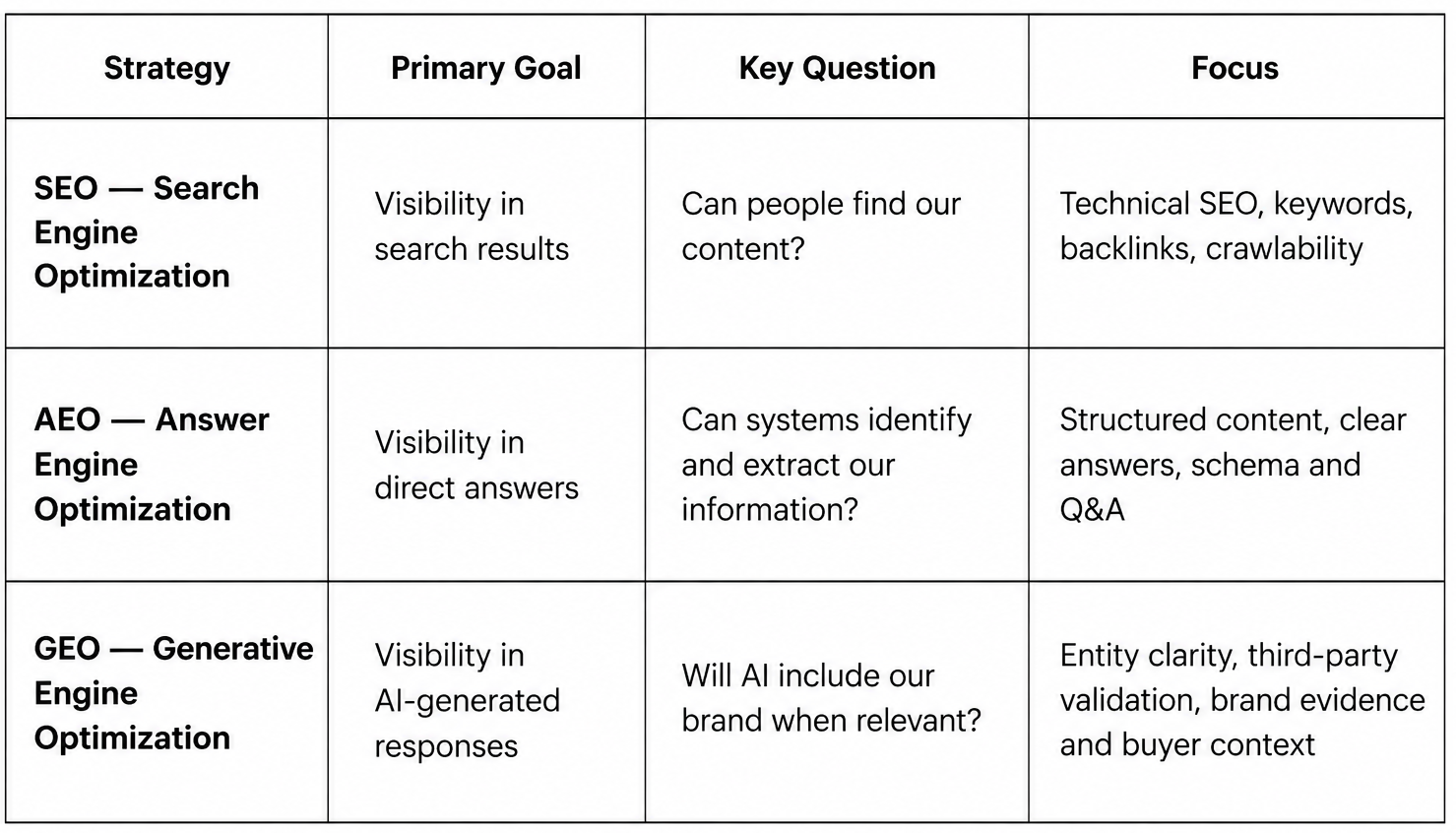
These should not be treated as competing strategies.
They build on one another.
SEO helps make your information discoverable.
AEO helps make important answers clear and accessible.
GEO focuses on improving the conditions for a brand to be accurately represented and surfaced in relevant AI-driven discovery.
The strategic distinction
GEO does not replace traditional SEO.
Strong visibility in AI-driven experiences still depends heavily on a foundation of accessible, crawlable, understandable and trustworthy information.
If your website is difficult to crawl, your product information is vague, your brand descriptions are inconsistent and nobody else accurately describes what you do, AI visibility becomes much harder to build.
The future of search is not SEO versus GEO.
It is increasingly:
SEO + AEO + GEO working together.
4. Why Good Brands Become Invisible in AI Answers
A company does not have to be a bad business to be poorly represented online.
Many strong brands become difficult for systems to understand because of four common blind spots.
Blind Spot #1: Inconsistent Brand Signals
Your website describes you one way.
Your LinkedIn profile says something different.
A directory uses an old company description.
A review platform lists outdated features.
An article categorizes you incorrectly.
Individually, these may seem like small inconsistencies.
Collectively, they can create a fragmented digital identity.
Search and AI systems benefit from clear, consistent information about:
- Who you are
- What you offer
- Who you serve
- What category you belong to
- What problems you solve
- What differentiates you
If the web presents multiple versions of your story, it becomes harder to establish a clear understanding of your brand.
Blind Spot #2: Your Most Important Information Is Hard to Find
Critical information is often hidden inside:
- Long PDFs
- Images containing important text
- Complex interactive interfaces
- Deep navigation structures
- Vague marketing copy
- Pages without clear headings or summaries
Consider the difference.
Vague marketing copy:
“We empower ambitious organizations to transform their customer engagement ecosystem.”
Clear entity definition:
“Acme CRM is a sales automation platform designed for growing sales teams that need lead management, follow-up automation and customer communication tools.”
The second version is better for both people and systems.
Clarity is not boring. Clarity is infrastructure.
Blind Spot #3: Nobody Else Is Talking About You
Your website is important, but it is only one part of your digital footprint.
Potential buyers—and the systems helping them research—can encounter information through:
- Industry publications
- Review platforms
- Comparison articles
- Professional communities
- Expert commentary
- Relevant directories
- Customer discussions
The goal is not simply to collect backlinks.
The larger objective is to build a credible, consistent body of brand evidence across the web.
Third-party mentions can provide additional context about what your business does, who it serves and how others describe it.
Blind Spot #4: Your Content Targets Keywords, Not Buyer Scenarios
Traditional SEO might target:
Accounting software
But a real buyer may ask:
“What accounting software can handle multi-currency invoicing for a remote service agency without requiring a complicated setup?”
The second query contains intent, context and constraints.
This is where content strategy needs to evolve.
Keyword research remains useful.
But keywords alone do not capture the full complexity of how people interact with AI systems.
Brands increasingly need content that addresses:
- Specific business situations
- Industry use cases
- Company-size requirements
- Feature combinations
- Constraints
- Comparisons
- Alternatives
- Buyer questions
The goal is not to abandon keywords.
It is to move from keyword targeting alone toward scenario-based discovery.
5. What Does AI Actually Know About Your Brand?
Before changing your content strategy, start with a simple question:
What does AI currently know about us?
Imagine a potential customer asks an AI platform about your category today.
Would your brand appear?
And if it does, would the description be correct?
Ask questions such as:
- Does the platform mention our company alongside relevant competitors?
- Does it correctly describe our core product?
- Does it understand our target audience?
- Are our differentiators represented accurately?
- Is it using outdated pricing information?
- Is it referencing discontinued features?
- Does it associate our brand with the wrong category?
An inaccurate answer can create friction before a potential customer ever reaches your website or speaks with your sales team.
That makes AI visibility more than a traffic issue.
It is also becoming a brand accuracy issue.
The objective is not to manipulate an AI system into recommending your company.
The objective is to make accurate information about your company easy to find, understand and verify across the digital ecosystem where buyers research you.
6. The Four Pillars of AI Search Readiness
Pillar 1: Entity Clarity
Your brand should be easy to identify without ambiguity.
Maintain consistency in:
- Company name
- Product name
- Core description
- Category
- Target audience
- Key features
- Official website
- Social and directory profiles
Structured data can also help communicate important information in a standardized format.
Depending on the page and content, relevant schema may include:
- Organization
- Product
- FAQPage
- Article
- Review-related structured data where appropriate
The principle is simple:
Make your important facts explicit rather than assuming systems will infer them from marketing language.
Pillar 2: Answer-First Content Architecture
Many websites make readers work too hard to find the answer.
A strong approach is:
Question or topic
↓
Direct answer
↓
Explanation
↓
Evidence or examples
↓
Comparison or next step
↓
Direct answer
↓
Explanation
↓
Evidence or examples
↓
Comparison or next step
Under important headings, provide a concise answer before expanding into detail.
Use:
- Descriptive H2 and H3 headings
- Short explanatory paragraphs
- Bullet points
- Comparison tables
- FAQs
- Clear product specifications
- Use-case examples
Tables, bullet points and well-structured sections can make important information easier for users and systems to interpret and retrieve.
Pillar 3: Third-Party Validation
A strong digital presence should not exist only on your own website.
Build credible coverage across relevant third-party ecosystems through:
- Industry publications
- Category roundups
- Review platforms
- Comparison resources
- Expert commentary
- Professional communities
- Relevant business directories
Digital PR is no longer only about media coverage.
Review management is no longer only about reputation.
Community participation is no longer only about engagement.
Together, these activities can help build a broader and more complete public understanding of your brand.
Pillar 4: Scenario-Based Intent Mapping
Your sales team probably hears questions that never appear in your keyword research spreadsheet.
For example:
- Which solution works for a five-person sales team?
- What is a simpler alternative to enterprise software?
- Which CRM is suitable for a business that relies heavily on WhatsApp?
- What tool can automate follow-ups without requiring a large operations team?
These are valuable content opportunities.
Document the questions your:
- Sales team hears
- Customer success team receives
- Support team answers
- Prospects ask during demos
- Customers raise during onboarding
Then turn those real-world questions into structured content.
The closer your content is to genuine buyer scenarios, the easier it becomes to demonstrate relevance when those scenarios appear in search or AI-driven conversations.
7. How Content Strategy Changes in the AI Search Era
The traditional content workflow often looks like this:
Keyword → Blog Post → Keyword Optimization
A more modern workflow can look like:
Buyer Question → Direct Answer → Supporting Evidence → Scenario → Comparison → Related Questions
From keywords to questions
Instead of creating an article around only:
B2B payroll software
Build content around questions such as:
How can a multi-location business manage payroll across different states without maintaining a large internal compliance team?
The keyword may still be relevant.
But the buyer's problem provides the context.
Lead with the answer
Do not bury your most important point after 800 words of introduction.
Where appropriate, answer the question early.
Then explain:
- Why
- How
- For whom
- Under what conditions
- What alternatives exist
Provide structured evidence
Use comparisons when comparing.
Use specifications when discussing specifications.
Use steps when explaining a process.
Use FAQs when answering recurring questions.
Structure should match the information being communicated.
Explain who your solution is for—and who it is not for
Marketing often tries to make every product sound suitable for everyone.
That can create vague positioning.
Clear boundaries can be more useful.
Explain:
- Ideal customer profile
- Common use cases
- Team size or business context
- Relevant requirements
- Situations where another type of solution may be more suitable
Specificity helps buyers understand fit—and helps prevent your positioning from becoming generic.
8. How to Audit Your Brand's AI Search Footprint
You do not need a complicated enterprise platform to begin evaluating your AI visibility.
Start with a structured set of prompts across relevant AI platforms.
1. Category Discovery
Ask:
What are the best [category] solutions for [specific audience]?
Example:
What are the best CRM platforms for a 20-person B2B sales team?
2. Problem Discovery
Ask:
How can a [type of business] solve [specific problem]?
Example:
How can a growing sales team reduce missed follow-ups without adding more manual reporting?
3. Brand Comparison
Ask:
What are the alternatives to [competitor or category]?
Or:
Compare [solution type] options for [specific use case].
4. Brand Verification
Ask:
What is [Your Brand], and who is it designed for?
Then evaluate:
- Was your brand included?
- Was the description accurate?
- Were your differentiators understood?
- Was outdated information presented?
- Which competitors appeared?
- Which sources were cited or surfaced?
- Did the answer match the buyer scenario?
Repeat the exercise over time using a consistent set of high-intent prompts.
Do not treat a single AI response as an absolute ranking or permanent result.
Results can vary by platform, prompt wording, location, available information, query context and changes to the underlying system.
The purpose is to identify patterns, gaps and inaccuracies.
9. New Metrics for the AI Search Era
Traditional SEO metrics remain important:
- Organic traffic
- Rankings
- Impressions
- Click-through rate
- Conversions
But marketing teams can begin tracking additional indicators of AI visibility.
Brand Mention Frequency
How often does your brand appear for relevant, non-branded buyer questions?
Recommendation Share
How frequently is your product included among relevant options compared with key competitors?
Source Citation Rate
How often is your website—or a credible third-party source discussing your brand—surfaced as supporting information?
Brand Accuracy Metric
Does the AI-generated description accurately reflect your:
- Product
- Target audience
- Features
- Positioning
- Pricing information
AI visibility measurement is still evolving, and results can vary across platforms and prompts.
The goal is not to chase a single universal GEO score. Build a repeatable monitoring process around the questions, use cases and competitors that matter most to your buyers.
10. The AI Search Readiness Checklist
Use this checklist to assess your current readiness:
- Is our company description consistent across our website, social profiles and major directories?
- Can someone understand what we do and who we serve within seconds of visiting our website?
- Are our important product facts clearly available in crawlable, accessible content?
- Do our key pages provide direct answers before lengthy explanations?
- Are important pages structured with clear headings, bullets, tables and FAQs where useful?
- Is relevant structured data implemented correctly?
- Are our product features and positioning consistent across third-party platforms?
- Are credible external sources accurately describing our brand?
- Are we creating content around real buyer scenarios rather than keywords alone?
- Have we tested how major AI platforms currently describe our business?
- Do we have a process for identifying outdated or inaccurate information?
- Are we tracking our visibility alongside relevant competitors?
Conclusion: Winning the Answer Engine Era
The competition for digital visibility is expanding from ranking among links to becoming part of the answer.
Traditional SEO remains foundational. Search rankings, technical performance, authoritative content and organic traffic will continue to matter.
But relying only on page-one visibility is no longer enough to understand how buyers discover and evaluate brands.
As AI-assisted search becomes part of the customer journey, businesses need to think beyond:
How do we rank for this keyword?
They also need to ask:
Can systems understand what we do?
Is the information about us accurate across the web?
Are we relevant to the real-world questions our buyers are asking?
The brands that win in the next era of search will not simply be the ones that publish the most content or target the greatest number of keywords.
They will be the brands that are:
- Easy to understand
- Easy to verify
- Clearly differentiated
- Consistently represented
- Relevant to real buyer questions
SEO helped brands get found.
AI-driven discovery is changing what happens after the question is asked.
The question for marketers is no longer only:
How do we rank?
It is increasingly:
When a customer asks for an answer, is our brand understood, accurately represented and relevant enough to be part of the conversation?
Frequently Asked Questions
What is AI search optimization?
AI search optimization is the process of making a brand's information easier for search and AI-driven answer systems to discover, understand and accurately represent when relevant. It combines SEO, clear content structure, entity consistency, schema and credible information across the wider web.
2. What is the difference between SEO, AEO and GEO?
SEO focuses on visibility in traditional search results. AEO focuses on making information clear and accessible for answer-based experiences. GEO focuses on improving the conditions for a brand to be accurately represented and surfaced in relevant AI-generated discovery.
No. GEO does not replace SEO. Technical SEO, crawlability, high-quality content and a trustworthy website remain important foundations. GEO expands the visibility strategy to consider how brands may appear in AI-driven discovery and answer experiences.
Test relevant buyer questions across AI platforms. Use category, problem, comparison and brand-verification prompts. Track whether your brand appears, whether the information is accurate, which competitors appear and which sources are surfaced.
Consistent descriptions across your website, profiles, directories, reviews and third-party coverage make it easier for search and AI-driven systems to interpret what your business does, who it serves and how it should be categorized.
Useful content includes direct answers, clear explanations, comparison pages, use-case content, FAQs, structured product information and scenario-based articles based on real customer questions