
A prospect shows interest. The sales conversation is moving well, the product appears to be a fit, and the buyer has not yet made a serious objection to the price.
Then the salesperson says:
“Let me see what discount I can offer you.”
The discount has entered the conversation before it needed to.
Once that happens, the dynamic changes. The discussion is no longer centered on why the solution is valuable. It becomes a negotiation about how much cheaper the solution can become.
For many businesses, early discounting is treated as a pricing issue. Management responds by tightening approval policies, setting minimum margin thresholds, or telling salespeople to negotiate harder.
But early discounting is rarely just a pricing problem.
It is often a deal confidence problem.
The salesperson may not feel confident defending the value of the solution. They may not fully understand the buyer's underlying problem. Or they may simply believe that reducing the price is the fastest route to a signed contract.
The result is predictable: margins shrink, buyers learn to expect concessions, sales teams become increasingly dependent on discounts, and the market is gradually trained to negotiate harder.
The solution is not simply to tell salespeople:
“Stop discounting.”
The solution is to build the confidence, discovery discipline, commercial guardrails, and visibility that allow them to protect value before reaching for price.
The True Cost of Early Concessions
Discounting is often a symptom of deeper commercial and operational gaps.
The financial impact of unnecessary price concessions can be much larger than it initially appears.
A McKinsey analysis of typical S&P 1500 company economics found that a 1% improvement in price, assuming stable sales volume, could increase operating profit by approximately 8%. The same analysis estimated that a company would need roughly an 18.7% increase in volume to offset the profit impact of a 5% price reduction. The exact impact varies by cost structure, but the broader principle is clear: price changes can have a disproportionately large effect on profitability. (McKinsey & Company)
A discount may help close one deal.
But if discounting becomes the default response to uncertainty, the impact compounds across the sales organization.
Margins fall.
Negotiation expectations rise.
And salespeople gradually learn that defending value is harder than simply reducing price.
Why Sales Teams Discount Too Early
Salespeople usually do not discount because they want to damage margins.
They discount because, in a high-pressure moment, a price reduction feels safer than defending value.
When a prospect says:
“Your price seems high.”
An uncertain salesperson may hear:
“The price is the problem.”
But that may not be what the buyer actually means.
The buyer could be saying:
- “I don't yet understand the return on this investment.”
- “I am comparing you with a cheaper alternative.”
- “I need help justifying this cost internally.”
- “I am not convinced this solves my biggest problem.”
- “I am testing how flexible you are willing to be.”
Responding to all of these situations with an immediate discount creates weak commercial discipline.
The real causes of early discounting often include:
1. Weak Qualification
Sales teams sometimes spend time trying to close prospects who were never a strong fit.
When value alignment is weak, price becomes the only lever left.
2. Poor Discovery
If the salesperson does not understand where the customer is losing time, money, opportunities, or productivity, it becomes difficult to connect the solution to a meaningful business outcome.
3. Unclear Value Communication
Knowing what a product does is not the same as explaining why it matters.
Features alone rarely create pricing confidence.
Business impact does.
4. Fear of Losing the Deal
Some salespeople interpret every price objection as an ultimatum.
Instead of exploring the concern, they immediately try to remove the objection through a discount.
5. Misaligned Incentives
If salespeople are rewarded only for revenue or deal volume, they may naturally prioritize closing quickly over protecting margins.
Price Objections vs. Value Objections
Not every statement about price is actually a price objection.
Understanding the difference is critical.
A Price Objection
The buyer understands the value of the solution but has a genuine concern about:
- Budget
- Timing
- Payment structure
- Cash flow
- Affordability
A Value Objection
The buyer is not yet convinced that:
- The solution solves the right problem
- The business outcome justifies the investment
- The expected return is clear
Weak Response: Treating Everything as a Price Objection
Buyer:
"This is more expensive than the alternative we are considering."
"This is more expensive than the alternative we are considering."
Salesperson:
"Let me check with my manager to see if I can match their price."
"Let me check with my manager to see if I can match their price."
The conversation immediately moves toward a concession.
Stronger Response: Diagnosing the Objection
Buyer:
"This is more expensive than the alternative we are considering."
"This is more expensive than the alternative we are considering."
Salesperson:
"I understand. Before we adjust the commercial terms, could you help me understand what you're comparing and which business outcomes matter most to your team?"
"I understand. Before we adjust the commercial terms, could you help me understand what you're comparing and which business outcomes matter most to your team?"
That question changes the conversation.
Instead of defending the price, the salesperson begins diagnosing the decision.
Diagnose before you discount.
7 Strategies to Build Deal Confidence
1. Improve Discovery Before Discussing Price
Price conversations become easier when the cost of leaving the problem unsolved has already been explored.
Discovery should uncover questions such as:
- What is the current problem costing the business?
- How much time is being lost?
- How much revenue is potentially at risk?
- What happens if nothing changes?
- Who is affected by the problem?
The stronger the discovery process, the easier it becomes to connect the solution to a meaningful business outcome.
A centralized CRM can help sales leaders review deal history, conversations, notes, and customer interactions so coaching is based on what actually happened during the sales process rather than assumptions. Flowzo CRM Deal Management
2. Teach Salespeople to Quantify Outcomes
Features explain what a product does.
Value explains why the buyer should care.
Feature-focused conversation
"Our platform automates workflow notifications and pipeline updates."
Value-focused conversation
"Your team currently spends several hours every week manually updating records and following up with prospects. Automating those activities can reduce administrative work and help ensure important leads receive timely attention."
The difference is significant.
The first statement describes functionality.
The second connects functionality to a business outcome.
Salespeople should be trained to move from:
Feature → Capability → Business Impact
Feature-focused selling versus value-focused selling and business impact
3. Treat Objections as Diagnostic Data
An objection tells you where uncertainty still exists.
Instead of immediately responding with a concession, train salespeople to pause and investigate.
For example:
Buyer:
"The price is high."
"The price is high."
Instead of:
"Let me see what discount I can offer."
Try:
"High relative to your budget, or relative to the return you expect to receive?"
That question creates space for the real issue to emerge.
The concern may be affordability.
It may be ROI.
It may be internal approval.
Or it may simply be a negotiation tactic.
Without diagnosing the objection, the salesperson cannot know.
4. Establish Reciprocal Commercial Guardrails
A discount should not be a one-way concession.
If the business gives something, it should ideally receive something in return.
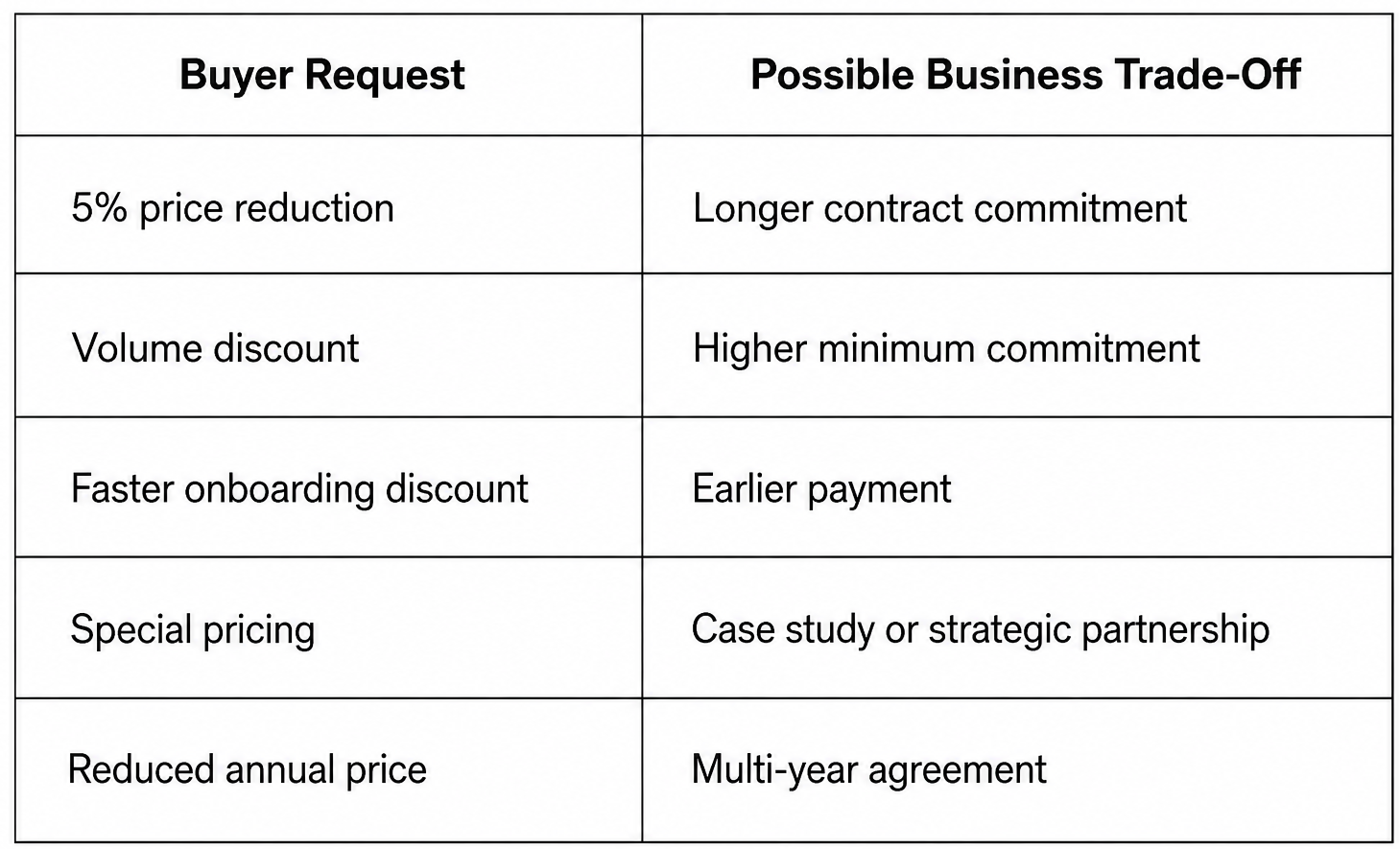
Give value. Get value.
This helps sales teams understand that discounts are commercial decisions, not emotional reactions.
5. Separate Salesperson Urgency From Buyer Urgency
One of the most common reasons for unnecessary discounting is internal pressure.
It is the end of the month.
The salesperson needs the deal.
The quota is close.
Management is asking for updates.
The seller becomes urgent.
The danger is assuming that the buyer is equally urgent.
They may not be.
A healthy sales process separates:
Seller urgency from buyer urgency.
The salesperson's quota deadline should not automatically become a reason to give away margin.
The important question is:
Why does the buyer need to make a decision now?
If there is no meaningful answer, discounting may simply be masking a weak buying case.
6. Track Discount Patterns in Your CRM
Management should look beyond revenue alone.
Sales leaders need visibility into how deals are actually being won.
Questions worth tracking include:
- Which salespeople discount most frequently?
- At what stage are discounts introduced?
- Which types of deals receive the largest concessions?
- Are discounted deals actually closing faster?
- Are certain products or customer segments driving margin leakage?
- Are discounts being offered before the buyer even asks?
A CRM with centralized deal activity, pipeline visibility, reporting, and performance tracking can help leaders identify patterns that would otherwise remain hidden. Flowzo CRM Features
The objective is not to punish salespeople for every discount.
It is to identify whether discounts are being used strategically—or simply as a substitute for stronger sales conversations.
7. Give Salespeople Better Commercial Playbooks
"Don't discount" is not a sales strategy.
Salespeople need alternatives.
A commercial playbook can provide options such as:
- Adjusting implementation scope
- Phasing the rollout
- Changing payment schedules
- Introducing a smaller starting package
- Offering longer commitments in exchange for better pricing
- Adding value instead of reducing price
- Involving a commercial decision-maker when appropriate
The goal is to give the salesperson more than one lever.
If price is the only tool available, price will eventually be used.
BUILD A SALES CULTURE
THE ROAD TO DEAL CONFIDENCE
The roadmap stages should match the blog:
1. Better Discovery
Understand the real problem and the cost of inaction.
Understand the real problem and the cost of inaction.
2. Quantify Value
Connect the solution to measurable business outcomes.
Connect the solution to measurable business outcomes.
3. Diagnostic Questions
Understand the objection before offering a concession.
Understand the objection before offering a concession.
4. Reciprocal Guardrails
If you give something, receive something in return.
If you give something, receive something in return.
5. Separate Buyer Urgency
Focus on the customer's timeline—not the seller's pressure.
Focus on the customer's timeline—not the seller's pressure.
6. Track Discount Patterns
Identify where, when, and why margin leakage happens.
Identify where, when, and why margin leakage happens.
7. Commercial Playbooks
Give salespeople better alternatives to discounting.
Give salespeople better alternatives to discounting.
Final destination
STRONG COMMERCIAL OUTCOMES
✓ Higher deal confidence
✓ Stronger margins
✓ Healthier growth
✓ Greater customer trust
✓ Stronger margins
✓ Healthier growth
✓ Greater customer trust
Brand lockup
Flowzo.ai
business flows intelligently
A Product of California Software Company Limited
business flows intelligently
A Product of California Software Company Limited
Suggested filename
road-to-deal-confidence-sales-culture.png
Alt text
Seven-step roadmap showing how sales teams can build deal confidence and protect commercial margins
Moving From Price Concessions to Commercial Discipline
Building deal confidence does not mean refusing every discount.
Strategic discounting can make sense.
A concession may help secure a larger commitment, accelerate a strategically important deal, or create a longer-term customer relationship.
The problem begins when discounting becomes the default response to uncertainty.
A strong commercial culture helps salespeople understand:
- When to defend value
- When to investigate objections
- When to negotiate
- When to offer a concession
- And what the business should receive in return
When discovery is stronger, value is clearer, and commercial boundaries are well defined, discounts become a strategic tool rather than an emotional default.
Don't Use Price to Solve a Confidence Problem
The next time a salesperson says:
"Let me see what discount I can offer you."
Ask a different question:
What problem are we actually trying to solve?
Is it truly a pricing problem?
Or is the salesperson uncertain about:
- The buyer's priorities?
- The value of the solution?
- The ROI?
- The competitive comparison?
- Or how to handle the objection?
Because reducing the price may close the conversation.
But it does not necessarily solve the underlying problem.
The strongest sales organizations do not simply train people to negotiate harder.
They build the systems, visibility, discovery discipline, and commercial confidence that allow salespeople to defend value first.
Build More Visibility Into Every Deal
Flowzo.ai helps sales teams centralize customer interactions, manage pipelines, track deal activity, automate follow-ups, and monitor sales performance from one connected platform. Its features include unified activity history, deal tracking, automation, call tracking integrations, and performance reporting. (FlowZo CRM)
When sales teams have better visibility into what is happening inside every deal, leaders can coach the behaviors behind revenue—not just measure the final result.
Frequently Asked Questions
Why do sales teams offer discounts too early?
Sales teams often discount early because of incomplete discovery, uncertainty about communicating value, fear of losing the deal, internal quota pressure, or a lack of clear negotiation frameworks.
Is discounting always bad for sales margins?
No. Strategic discounting can support larger commitments, longer contracts, faster payment terms, or other commercially valuable outcomes. It becomes harmful when it is an automatic response to buyer hesitation.
What is the difference between a price objection and a value objection?
A price objection occurs when the buyer understands the value but has genuine concerns about budget, affordability, timing, or payment terms.
A value objection occurs when the buyer is not yet convinced that the solution or expected outcome justifies the investment.
How can sales leaders reduce unnecessary discounting?
Sales leaders can improve discovery, train teams to quantify business value, establish reciprocal negotiation guardrails, track discount patterns, and provide salespeople with clear commercial playbooks.
Deal confidence is a salesperson's ability to guide commercial conversations, understand objections, communicate value, and negotiate without immediately relying on price reductions.