
Your Pipeline May Look Healthy. But Is It?
A salesperson finishes a demo.
The prospect says:
“Send me the proposal and we'll review it.”
The salesperson sends it, moves the opportunity into Proposal, and adds the deal to the forecast.
On the dashboard, the pipeline has just grown.
But has the deal actually progressed?
The buyer hasn't confirmed the budget.
The decision-maker wasn't involved.
There is no agreed procurement process.
The salesperson moved the deal forward.
The buyer didn't.
This is stage inflation—when a deal advances because the salesperson completed an activity, rather than because the buyer reached a meaningful milestone.
And that's only half of the problem.
There is another kind of opportunity sitting quietly in many CRMs:
Zombie deals.
They haven't been officially lost. Nobody has closed them. The close date keeps moving, and the deal continues to sit in the pipeline even though the buyer has stopped showing meaningful interest.
Stage inflation pushes deals forward too early.
Zombie deals keep them alive too long.
Both make the pipeline look healthier than it really is.
What the Numbers Tell Us
Pipeline discipline isn't just a CRM housekeeping exercise.
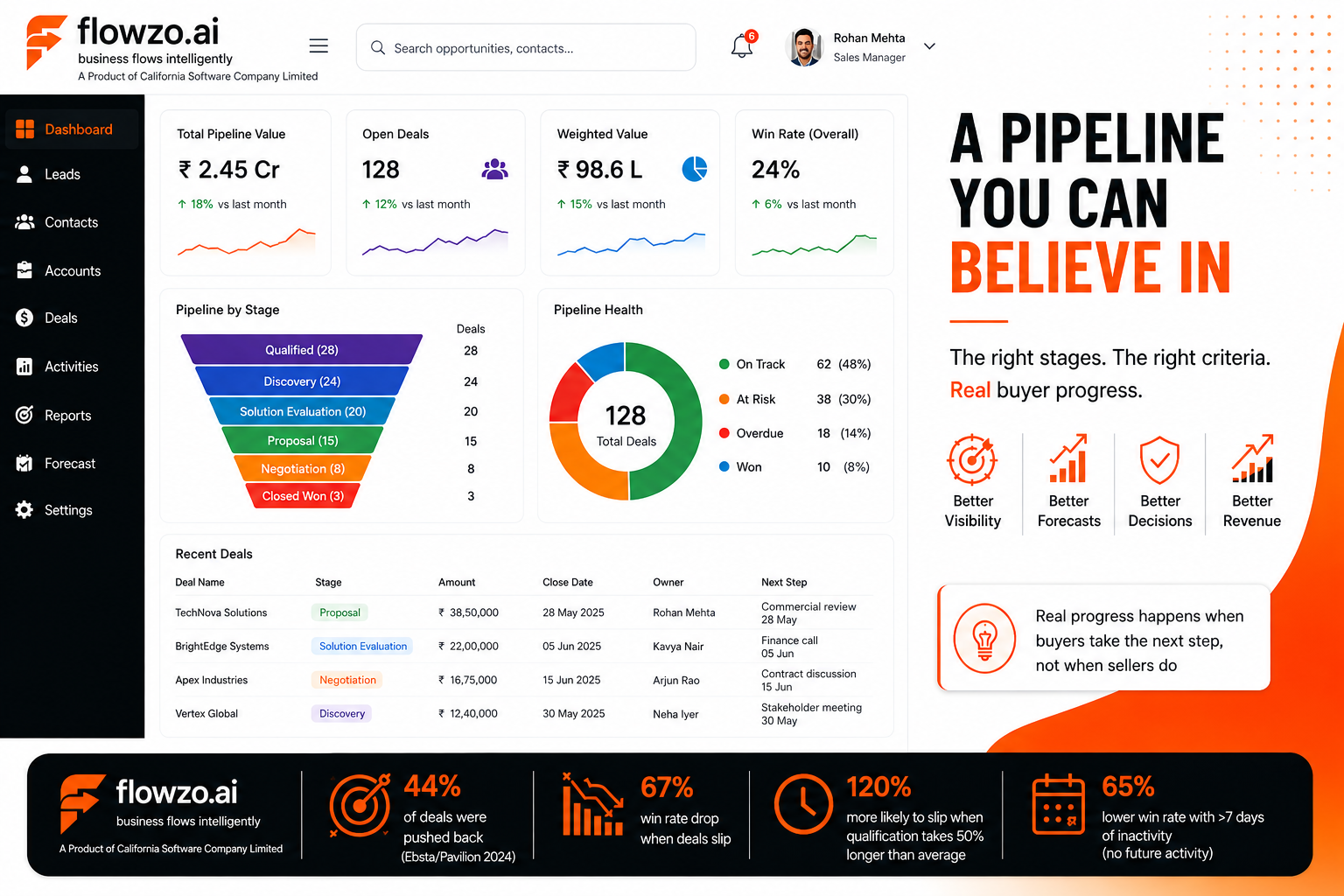
Research associated with Vantage Point Performance and published through Harvard Business Review has found that companies with effective pipeline-management practices and trained salespeople achieved 28% higher revenue growth than companies with ineffective pipeline management.
The more recent Ebsta/Pavilion benchmark gives us another reason to pay attention.
Its analysis covered 4.2 million opportunities across 530 companies, representing $54 billion in revenue. It found that 44% of deals were pushed back, and when deals slipped, win rates dropped 67%.
The warning signs can appear much earlier.
When qualification took 50% longer than average, an opportunity was reported to be 120% more likely to slip.
And Ebsta's 2025 qualification research, based on more than 655,000 B2B opportunities worth $48 billion, found that well-qualified deals were 6.3× more likely to close and closed 21.6% faster.
The lesson is not “put more deals into the pipeline.”
It is:
What Are Sales Pipeline Stages?
Sales pipeline stages are the steps an opportunity passes through as a buyer moves from initial interest toward a commercial decision.
A typical B2B pipeline might look like:
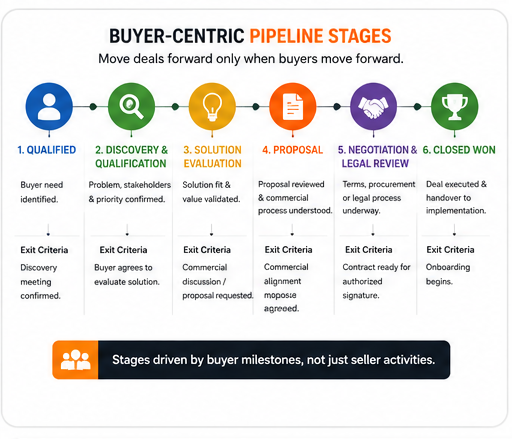
Qualified → Discovery → Solution Evaluation → Proposal → Negotiation → Closed-Won
But the names aren't what make a pipeline useful.
The important question is:
What has to happen before a deal is allowed to move from one stage to the next?
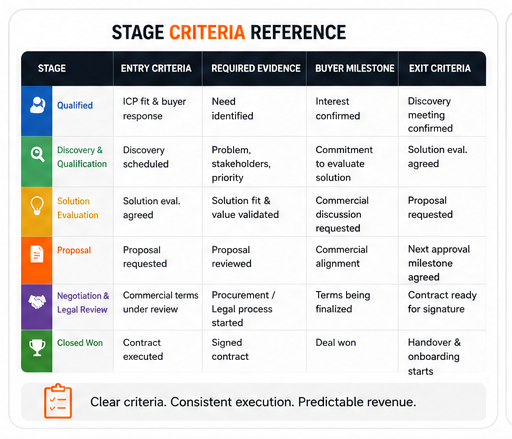
A good stage definition should answer four things:
Entry criteria — What must be true before the opportunity enters?
Required evidence — What needs to be documented?
Buyer milestone — What has the buyer actually confirmed?
Exit criteria — What needs to happen before the opportunity advances?
Without these rules, two salespeople can look at the same deal and make completely different decisions about what stage it belongs in.
Stop Measuring Seller Activity as Buyer Progress
This is one of the easiest ways for a pipeline to become misleading.
Consider the difference:
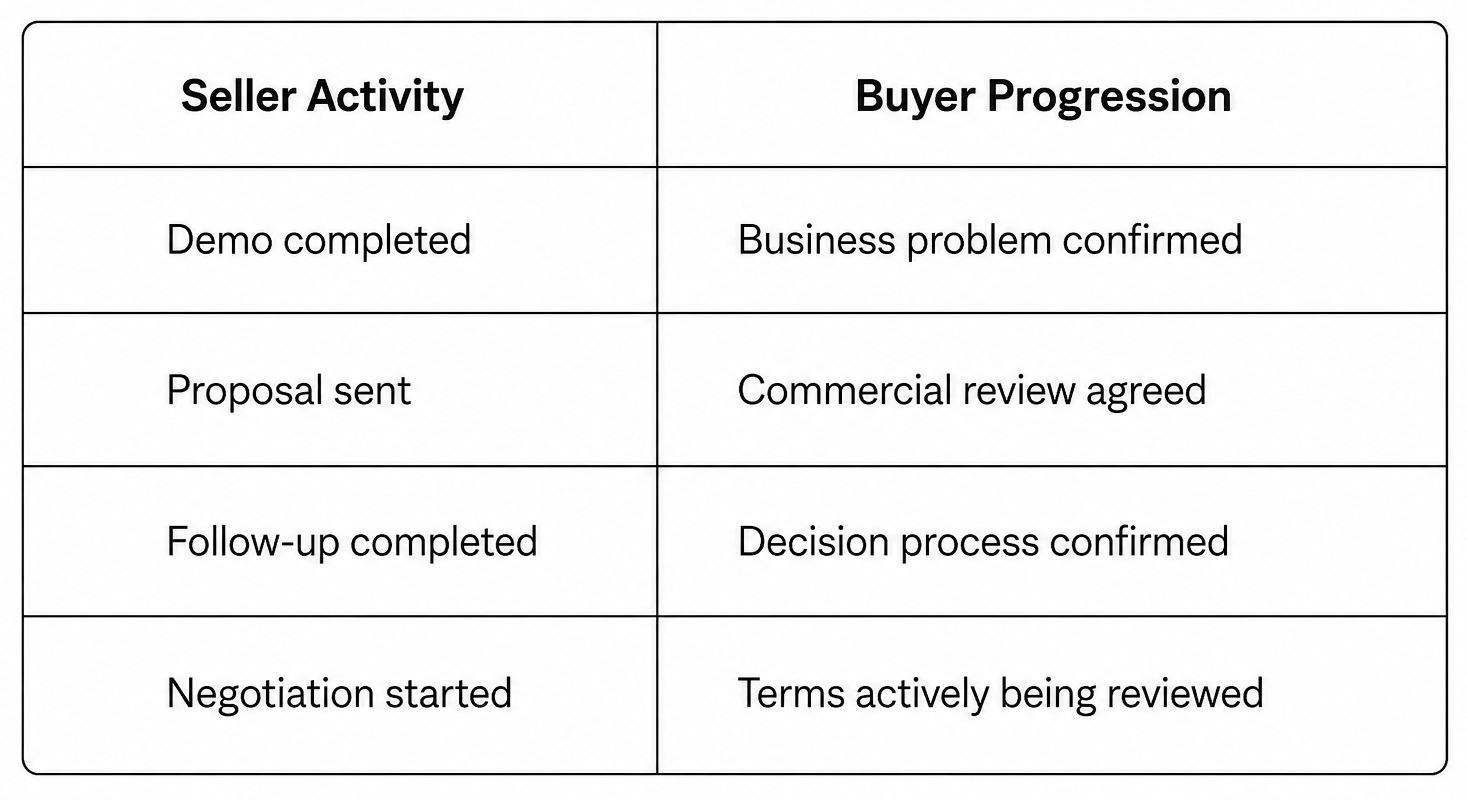
A salesperson can complete ten activities without the buyer taking one meaningful step.
That's why a healthy pipeline should reflect what has changed on the buyer's side, not simply what the salesperson has done.
The 6 Sales Pipeline Stages
1. Qualified
Purpose: Establish basic fit and genuine interest.
Entry: The prospect fits your ideal customer profile and has responded or engaged.
Evidence: A relevant business need has been identified.
Exit: The buyer agrees to a discovery conversation.
2. Discovery & Qualification
This is where the sales team should understand the actual problem—not simply collect contact information.
Entry: Discovery is scheduled.
Evidence: Problem, business impact, stakeholders and buying priorities are documented.
Exit: The buyer confirms the problem is worth solving and agrees to evaluate a relevant solution.
This stage deserves special attention. Ebsta's research found that when qualification lasted 50% longer than average, the opportunity was 120% more likely to slip.
3. Solution Evaluation
Now the question becomes:
Can the proposed solution actually solve the buyer's problem?
Entry: A solution evaluation or relevant demonstration is agreed.
Evidence: Solution fit and value are validated.
Exit: The buyer requests or agrees to move into commercial discussion.
4. Proposal
This is where stage inflation often begins.
Sending a proposal doesn't automatically mean the opportunity is truly at Proposal stage.
Entry: Solution fit is established and the buyer has requested a commercial proposal.
Evidence: The proposal has been reviewed and the commercial process is understood.
Exit: Commercial alignment exists and the next approval, procurement or decision milestone is agreed.
The difference is important:
“Proposal sent” is an activity.
“Proposal reviewed and commercial next step agreed” is progression.
5. Negotiation & Legal Review
Purpose: Finalize the commercial and contractual details.
Entry: The buyer is actively reviewing terms.
Evidence: Procurement, legal, commercial or approval processes are underway.
Exit: Final agreement is ready for authorized signature.
6. Closed-Won
Entry: The agreement is formally executed.
Action: Customer and implementation details are handed over to the appropriate team.
Outcome: Customer onboarding begins.
Stage Inflation and Zombie Deals Are Not the Same
They are connected, but they describe two different problems.
Stage Inflation
The opportunity moves forward too early.
Example:
Demo completed → Proposal
even though the buyer hasn't confirmed budget, decision-makers or commercial intent.
Zombie Deal
The opportunity stays open too long.
Example:
Proposal → 60 days → no buyer response → close date moved again
So remember:
Stage inflation pushes fictional deals forward. Zombie deals keep them alive.
Both distort the forecast.
The Anatomy of a Zombie Deal
A zombie deal isn't necessarily a hard “No.”
It's often a non-responsive “Maybe.”
It remains open in the CRM, but there is little evidence that the buyer is still actively moving toward a decision.
Common warning signs
The Close-Date Shuffle
The expected close date has been moved repeatedly without a clear buyer reason.
The expected close date has been moved repeatedly without a clear buyer reason.
Buyer Ghosting
The buyer has stopped responding or has missed scheduled conversations.
The buyer has stopped responding or has missed scheduled conversations.
No Agreed Next Milestone
The CRM says “follow up next week” rather than showing a specific buyer action.
The CRM says “follow up next week” rather than showing a specific buyer action.
One-Sided Engagement
The salesperson keeps sending emails and making calls, but meaningful buyer responses have stopped.
The salesperson keeps sending emails and making calls, but meaningful buyer responses have stopped.
Single-Threaded Contact
The entire opportunity depends on one contact who isn't the decision-maker or may no longer have internal influence.
The entire opportunity depends on one contact who isn't the decision-maker or may no longer have internal influence.
Excessive Time in Stage
The opportunity has remained in the same stage far longer than your own historical benchmark.
The opportunity has remained in the same stage far longer than your own historical benchmark.
The inactivity problem is not trivial. Ebsta's benchmark reported that more than seven days of inactivity with no future activity was associated with a 65% reduction in win rates.
Why Do Reps Hold on to Zombie Deals?
Usually, it isn't because someone is deliberately trying to make the pipeline look better.
There are understandable reasons.
Quota Anxiety
Removing a large opportunity can make pipeline coverage suddenly look much worse.
Sunk-Cost Thinking
After spending hours on demos, meetings and proposals, it is difficult to accept that the opportunity may not go anywhere.
No Clear Rule
If the CRM doesn't flag stalled deals or require meaningful next steps, the easiest thing is often to leave the opportunity where it is.
That's how a 30-day delay becomes 60 days.
Then 90.
And eventually nobody remembers why the deal is still open.
How to Purge Zombie Deals Without Losing Good Opportunities
The answer isn't to automatically close every old deal.
Use a simple four-step process.
1. Check Days in Stage
Sort open opportunities by how long they have been in their current stage.
Compare that against your own historical sales data.
Avoid arbitrary rules such as “every deal older than 30 days is dead.” Different businesses have different sales cycles.
2. Test Buyer Intent
Ask the salesperson:
- When did the buyer last respond meaningfully?
- Is there a specific, dated next milestone?
- Is the business problem still a priority?
- Is the economic buyer or relevant decision-maker engaged?
If most answers are “No,” the deal needs attention.
3. Give the Buyer an Easy Exit
Before closing a potentially recoverable opportunity, a simple permission-to-close message can remove the ambiguity.
Subject: Should I close this out for now?
Hi [First Name],
I haven't heard back regarding [Project/Solution], so I'm assuming this may no longer be a current priority.
I'll close out the active follow-up for now so I don't keep adding to your inbox.
If the project becomes a priority again, I'm happy to reconnect.
Best,
[Rep Name]
[Rep Name]
The point isn't to pressure the buyer.
It is to stop the sales team from chasing an opportunity indefinitely without evidence of intent.
4. Recover, Nurture or Close
If the buyer responds with a genuine next step:
Recover.
If the project is real but timing has changed:
Nurture.
If there is no credible path forward:
Closed-Lost.
The goal isn't to make the pipeline smaller.
The goal is to make it believable.
Three Controls That Keep the Pipeline Clean
1. Stage Gates
Require important information before a deal can advance.
Depending on your process, this might include:
- Business problem
- Economic buyer
- Budget status
- Decision process
- Buyer milestone
- Next action
2. Stage-Age Alerts
Flag deals that exceed your historical stage-duration benchmark.
The alert should start a conversation—not automatically kill the opportunity.
3. Next-Step Compliance
Every active deal should have a specific, dated next action.
Not:
“Follow up next week.”
But:
“Commercial review with Finance — Thursday, 3 PM.”
The importance of this is reinforced by Ebsta's benchmark: top performers were reported to be 412% more likely to have a next step or meeting defined.
The 15-Minute Weekly Pipeline Audit
Pipeline reviews don't have to become another two-hour meeting.
Try this every Monday.
0–4 minutes: Find stalled deals
Look at stage age and identify opportunities that have stopped moving.
4–8 minutes: Check next actions
Make sure every active deal has a specific next step.
8–12 minutes: Find stage friction
Look for stages where opportunities repeatedly slow down or disappear.
12–15 minutes: Clean the forecast
Review deals with:
- No recent buyer activity
- Repeated close-date changes
- Missing next steps
- Weak stage evidence
Then decide:
Recover → Nurture → Closed-Lost
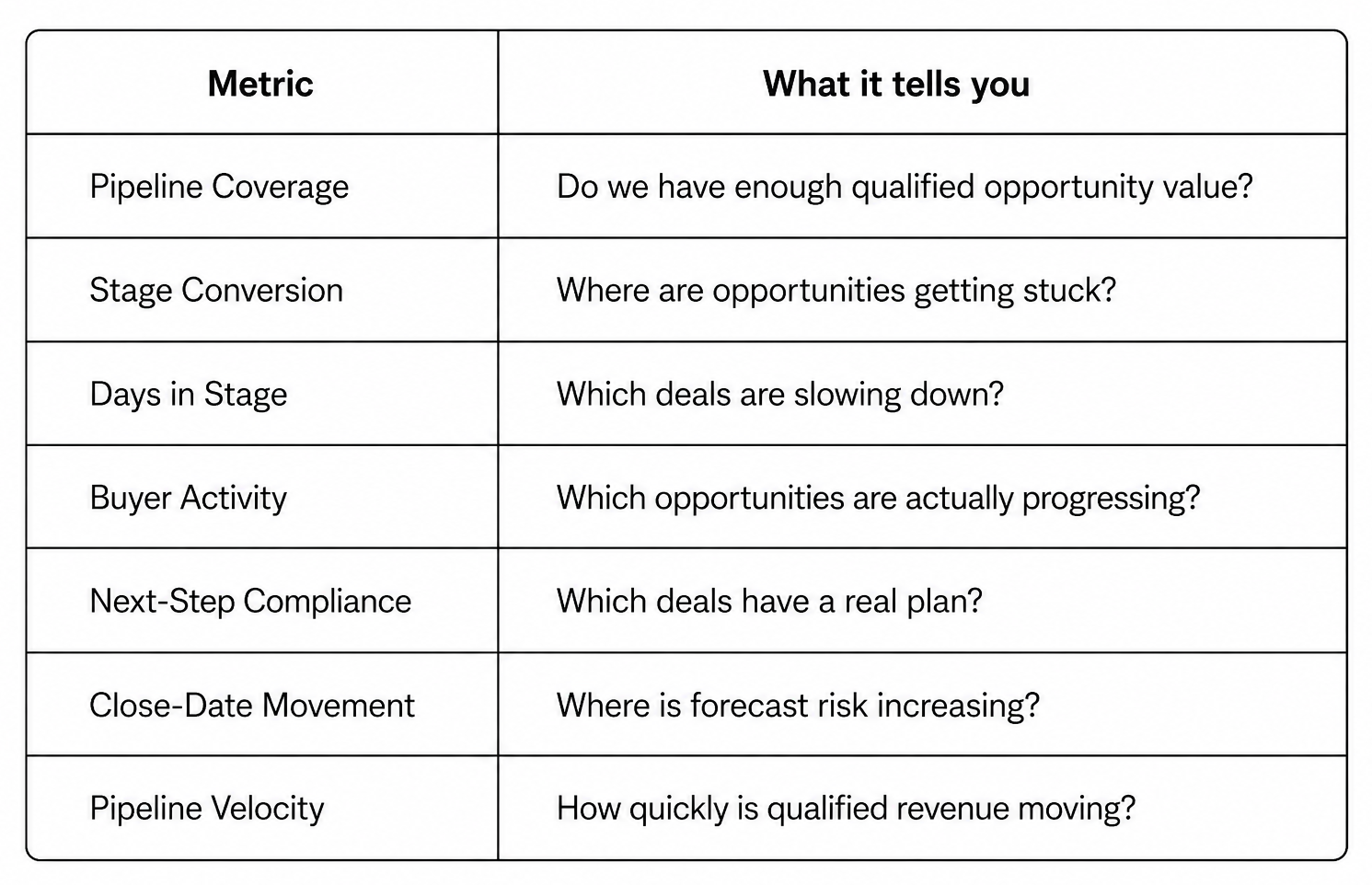
The Pipeline Metrics Worth Watching
Total pipeline value tells only part of the story.
Frequently Asked Questions
What is Email Sequencing?
Email Sequencing is a structured series of follow-up communications delivered according to predefined business rules that help sales teams maintain consistent communication with prospects throughout the buying journey.
Is Email Sequencing the same as Email Marketing?
No. Email Marketing targets large audiences with newsletters, promotions, and announcements.Email Sequencing supports one-to-one sales conversations by delivering structured follow-ups that move individual opportunities forward.
Does Email Sequencing improve sales performance?
Email Sequencing improves consistency, reduces missed follow-ups, and helps sales teams maintain momentum with prospects. While results depend on message quality, timing, and the overall sales process, a structured follow-up approach generally supports better sales execution.
How many follow-ups should a sales team send?
There is no universal number.The ideal cadence depends on your industry, buying cycle, customer preferences, and the value each interaction provides.Quality and relevance are far more important than volume.
Can small businesses benefit from Email Sequencing?
Absolutely.Small businesses often benefit significantly because structured follow-up reduces manual effort while helping lean sales teams manage growing pipelines more consistently.
Does Email Sequencing replace personal communication?
No. It automates routine scheduling and reminders while allowing sales professionals to focus on meaningful conversations and relationship building.
What makes an effective Email Sequence?
An effective sequence combines:- Clear objectives
- Relevant messaging
- Appropriate timing
- Personalization
- Consistency
- Valuable content
- A clear next step
Clear objectives
Relevant messaging
Appropriate timing
Personalization
Consistency
Valuable content
A clear next step