
The Ultimate Buyer's Guide to Telecalling CRM Software in India
A CRM is not an expense when it prevents revenue leakage. It becomes an expense when your team uses it only to store data.
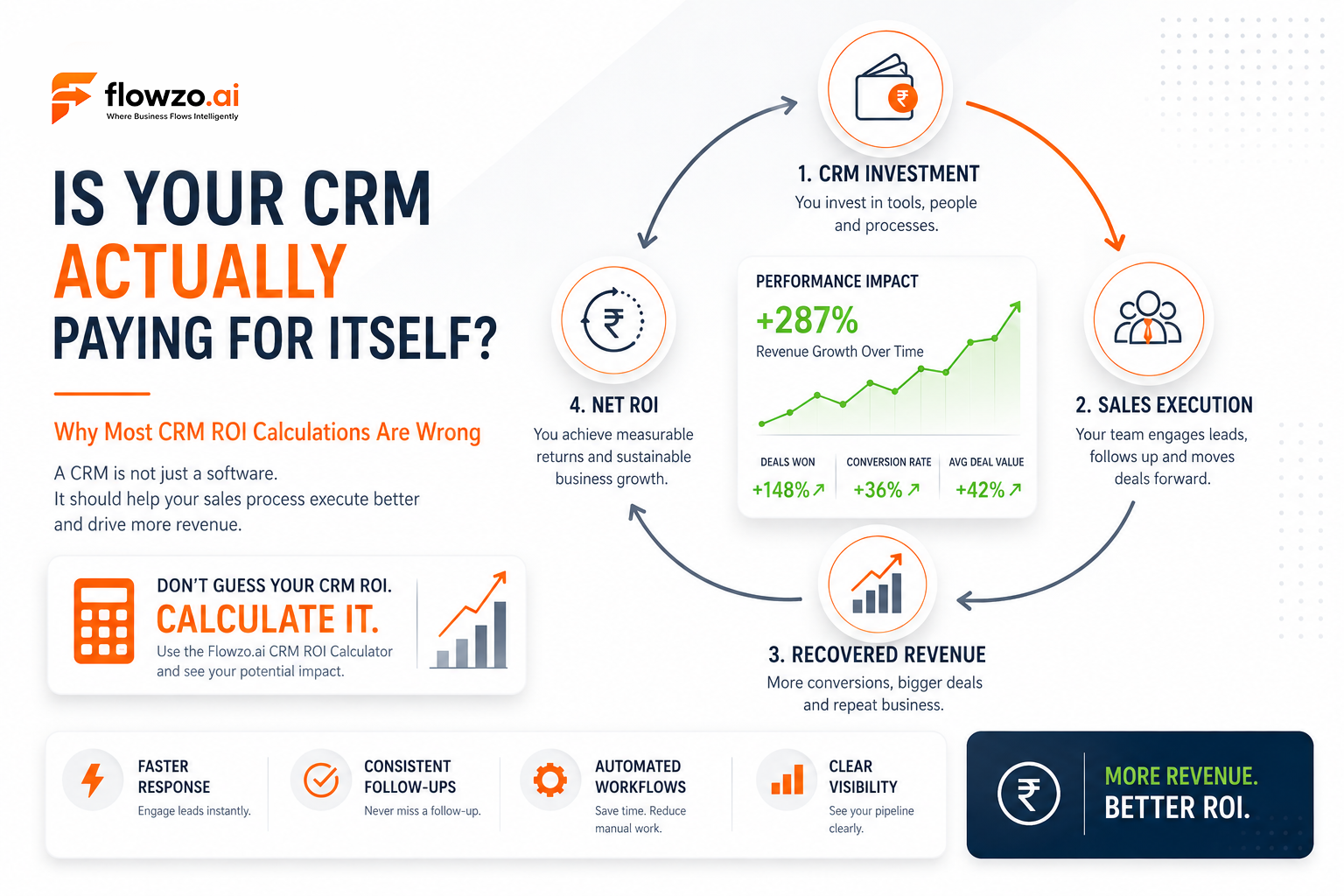
So, is your CRM actually paying for itself $
The answer isn't found by looking at your monthly subscription bill. It is found in the leads you recover, the follow-ups your team doesn't miss, the sales hours you give back, and the opportunities that no longer disappear from your pipeline.
That's why many CRM ROI calculations miss the real picture. They measure what the software costs-but not what poor sales execution is costing the business.
A founder compares subscription prices.
A sales manager compares features.
Finance calculates the annual software bill.
Meanwhile, a lead sits untouched for three hours.
A follow-up gets forgotten.
A salesperson spends the afternoon updating spreadsheets.
And an opportunity quietly goes cold.
Those costs rarely appear on the CRM invoice. But they still affect your bottom line.
What Is Real CRM ROI?
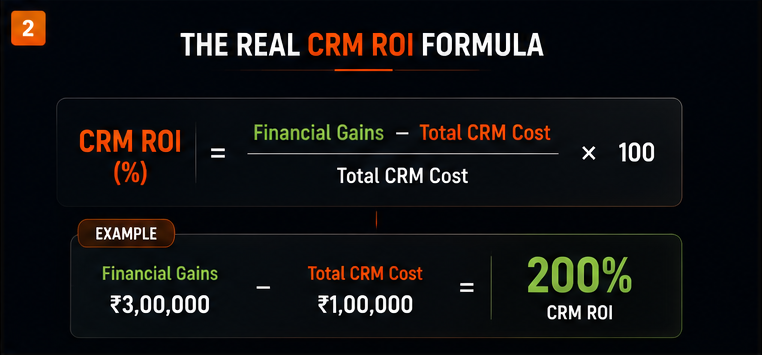
CRM ROI measures the financial return generated by a CRM compared with the total cost of owning and operating it.
The basic formula is:
For example, suppose a business spends Rs1,00,000 per year on its CRM and generates Rs3,00,000 in measurable financial gains from increased sales, productivity and process improvements.
Its ROI would be:
That means the business generated 2 in net return for every Rs1 invested.
But there is an important catch.
The calculation is only as good as the numbers you put into it.
And this is where many CRM ROI calculations go wrong.
The CRM ROI Blind Spot
Most companies calculate something like this:
CRM cost - additional revenue - ROI
A better model looks like this:
CRM investment - revenue gained + time saved + leads recovered + process efficiency + reduced leakage
Why does that matter?
Because CRM value doesn't always appear as a new sale on tomorrow's revenue report.
Imagine a sales representative saves 90 minutes every day because lead assignment, reporting and follow-up reminders are automated.
That is productive time.
Imagine 20 leads that previously went unworked are now automatically assigned to salespeople.
Those are recovered opportunities.
Imagine management discovers that a large part of the pipeline has had no meaningful activity for weeks.
That is visibility into revenue risk.
None of these should be ignored when evaluating CRM ROI.
CRM ROI isn't just about selling more. It's also about wasting less.
CRM ROI by the Numbers: 3 Stats Worth Knowing
The numbers behind CRM ROI tell an interesting story: the biggest returns aren't always where businesses expect them.
usd3.10
Average return for every usd1 invested in CRM
Nucleus Research's 2024 analysis of 11 CRM ROI case studies found an average return of $3.10 for every dollar spent. The figure is a benchmark, not a guarantee; actual ROI depends on implementation, adoption, processes and the outcomes being measured. (Nucleus Research)
51 percentage
Of total CRM ROI came from productivity and process-efficiency improvements
The same Nucleus Research analysis found that individual productivity gains and improvements to overall process efficiency accounted for 51% of total CRM ROI. (Nucleus Research)
That changes the way CRM should be evaluated.
CRM ROI isn't simply:
More software - more sales
It can also be:
Less manual work - more selling time - better process efficiency - greater business value
Higher conversion rates when inbound leads were contacted within the first five minutes
InsideSales' 2021 Lead Response Study reviewed more than 55 million sales activities and 5.7 million inbound leads across 400+ companies. Its research reported that conversion rates were 8× greater when contact was attempted within the first five minutes.
This should not be interpreted as a promise that every business will achieve an eightfold increase.
The broader lesson is more useful:
Speed-to-lead is a revenue variable.
Understanding this distinction is important.
Many businesses invest heavily in email marketing while leaving sales follow-up entirely manual.
The result is strong lead generation followed by inconsistent execution.
Marketing creates opportunities.
Email Sequencing helps convert those opportunities into meaningful sales conversations.
Why Email Alone Is No Longer Enough
Today's customers don't communicate through a single channel.
Some respond to email.
Others prefer scheduled phone conversations.
Some engage through messaging platforms like WhatsApp.
Others simply need timely reminders before making a decision.
Modern sales teams therefore think in terms of complete customer journeys rather than isolated communication channels.
A structured multi-channel cadence might look like this:
- Day 1: Introduction email
- Day 3: Helpful educational content
- Day 5: Phone call reminder
- Day 8: Industry insight
- Day 12: Meeting invitation
- Day 16: Final check-in
Notice something important.
This isn't about sending more messages.
It's about delivering the right message at the right time.
Consistency builds familiarity.
Familiarity builds trust.
Trust creates conversations.
Conversations create customers.
Manual Follow-Up vs Rule-Based Sequencing
Knowing
The numbers behind CRM ROI tell an interesting story: the biggest returns aren't always where businesses expect them.
$3.10
Average return for every usd1 invested in CRM
Nucleus Research's 2024 analysis of 11 CRM ROI case studies found an average return of $3.10 for every dollar spent. The figure is a benchmark, not a guarantee; actual ROI depends on implementation, adoption, processes and the outcomes being measured. (Nucleus Research)
51%
Of total CRM ROI came from productivity and process-efficiency improvements
The same Nucleus Research analysis found that individual productivity gains and improvements to overall process efficiency accounted for 51% of total CRM ROI. (Nucleus Research)
That changes the way CRM should be evaluated.
CRM ROI isn't simply:
More software - more sales
It can also be:
Less manual work - more selling time - better process efficiency - greater business value
Higher conversion rates when inbound leads were contacted within the first five minutes
InsideSales' 2021 Lead Response Study reviewed more than 55 million sales activities and 5.7 million inbound leads across 400+ companies. Its research reported that conversion rates were 8× greater when contact was attempted within the first five minutes. (InsideSales)
This should not be interpreted as a promise that every business will achieve an eightfold increase.
The broader lesson is more useful:
Frequently Asked Questions
What is Email Sequencing?
Email Sequencing is a structured series of follow-up communications delivered according to predefined business rules that help sales teams maintain consistent communication with prospects throughout the buying journey.
Is Email Sequencing the same as Email Marketing?
No. Email Marketing targets large audiences with newsletters, promotions, and announcements.Email Sequencing supports one-to-one sales conversations by delivering structured follow-ups that move individual opportunities forward.
Does Email Sequencing improve sales performance?
Email Sequencing improves consistency, reduces missed follow-ups, and helps sales teams maintain momentum with prospects. While results depend on message quality, timing, and the overall sales process, a structured follow-up approach generally supports better sales execution.
How many follow-ups should a sales team send?
There is no universal number.The ideal cadence depends on your industry, buying cycle, customer preferences, and the value each interaction provides.Quality and relevance are far more important than volume.
Can small businesses benefit from Email Sequencing?
Absolutely.Small businesses often benefit significantly because structured follow-up reduces manual effort while helping lean sales teams manage growing pipelines more consistently.
Does Email Sequencing replace personal communication?
No. It automates routine scheduling and reminders while allowing sales professionals to focus on meaningful conversations and relationship building.
What makes an effective Email Sequence?
An effective sequence combines:- Clear objectives
- Relevant messaging
- Appropriate timing
- Personalization
- Consistency
- Valuable content
- A clear next step
Clear objectives
Relevant messaging
Appropriate timing
Personalization
Consistency
Valuable content
A clear next step